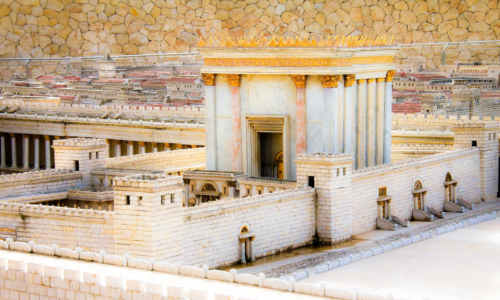
The Temple, G-d and You
We think of our times and the conditions under
which we live as normal. It's "normal" for some of us to do the wrong
things on Shabbos - some of the time. It's normal for us to eat without
knowing if the food is quite kosher or to eat without a proper blessing.
It's normal for us to assume it's impossible to go a whole day - even one
whole hour - without sin. And it's normal for us to feel just a little
guilty about it, but to continue on anyway. After all, what's there
to do?
Imagine if there was something you could do?
Imagine if right after a mistake (or at the next festival, if you're in
no great hurry), it was possible to travel to Jerusalem and enter this
most beautiful of buildings with an animal or flour offering. Once
there, we would place the offering in the warm hands of a Kohen - a priest
who is trained to perfection in the art of the Temple service - and watch
him offer our animal on the altar.
What a feeling of release from burden!
We've betrayed our mission and our unending debt to G-d... and He's still
willing to forgive us! As the animal burns on the altar - where we
should have been if we were judged as our actions deserved - we are given
a clean slate to start with, like a newborn baby.
What a joy that must have been!
What else is "normal" in our lives? What
about the Tumah - impurity? We're so insensitive to Tahara (purity)
that we don't even feel its absence. But there's no doubt that if
we could become Tahor, our minds would become clearer, we would be able
to learn more Torah and we could come closer to real love of G-d.
Until the Temple will be built, there will
be no complete Tahara.
We all know how hard it is to get excited about
Mitzvos (commandments). It's almost like someone's built a wall between
the world of divine service and this murky, mundane world. Somehow our
hearts and minds became stuck on the wrong side and we can't seem to break
through the wall. Imagine that barrier lifted away, leaving nothing
but our own decision standing between ourselves and the people we could
become.
Imagine all this, and you imagine a Temple. May it be rebuilt in our day.
Sacrifices
How do Korbonos (sacrifices) help us? To
answer that, we'll have to think just a bit about the purpose of the Temple
sacrifice. Of course, all we can do is scratch at the surface, or perhaps
catch a glimpse of one aspect of the whole subject. The true depths
of the Divine master plan are hidden from us all - and especially someone
of my limited capabilities. Here, we'll follow, as best we can, the
thoughts of the book, "Sefer Hachinuch" (mitzva 95).
G-d expects and wants nothing more of us than
to fear Him with pure hearts and serve Him to the best of our abilities.
And we've been given the means to reach that goal the Mitzvos (commandments).
The pure heart is the center of a G-dly life.
But man is drawn after his actions. What he does has a greater
affect than what he says or thinks.
When we do something wrong - when we, in effect,
rebel against G-d's rule - is there anything that can undo the damage?
How can we make it as though the mistake had never been done? There is
Teshuva (repentance). There is regret for the past slip and the promise
to try to never do it again. That G-d has given us this wonderful
gift of Teshuva is in itself a great kindness.
Teshuva is wonderful, but we sometimes need
inspiration, road markers to help us along the way.
Partly to that end, G-d commanded us to set
aside a place of high purity, apart from the rest of the mundane world.
This place would be the site of undiluted divine service, of priests working
tirelessly at their tasks, of the fulfillment of the Will of G-d.
It was to this place (the Temple) that we
would come after a fall. What better medicine could there be for
someone who has just stumbled than to spend time in the place where the
proper service of G-d was not only in practice, but at its peak?
But we wouldn't only watch. Remember,
we are drawn after our actions! Our animal (or bird) offering was
taken from us and slaughtered (for don't we deserve as much for rebelling
against the true King?).
Each part of the service should bring us to
think seriously about our lives and the way we use our bodies and minds.
The very fact that we are giving up such and expensive and desired animal
leads us to wonder at our priorities. Is owning things like this really
the object of my life's work?.
And it isn't just the sin offering (the chatos)
that should get us thinking. Each offering and service in the Temple
contains its own library of thoughts. A trip to Jerusalem can, if
used properly, be a source of growth in our Jewishness. Each type
of Mitzva and each area of G-dly life is addressed by something in the
temple service. All we have to do is think a little...
There are far too many details to this subject
than could ever be put to paper. I can only advise the
reader to look up the "Sefer Hachinuch" mentioned above, and the commentary
to Chumash of Rabbi S.R. Hirsch (Parshos Teruma, T'zave, Vayikra and Tzav).
Rabbi Boruch Clinton teaches at the Ottawa Torah Institute yeshiva high
school and Machon Sarah high school for girls (both in Ottawa, Canada).
You may reach him with comments and questions at
bclinton@torah.org.
You can now read some of Rabbi Clinton's essays on Torah life at
http://www.ncf.ca/~es625/essays
You can also buy his collection of essays on
the Book of Shmuel (Samuel) in printed form at
www.lulu.com/marbitzmedia
Copyright © 2000 by Rabbi
Boruch
Clinton and Project Genesis, Inc.