


Finally, there is a holiday observance that all Jews can get behind. Attending a seder remains pretty popular, but there is that chametz rule that gets in the way for the non-observant. Apples and honey on Rosh Hashanah has a shot at the distinction, but would the committed Jew really consider it a major observance? Yom Kippur and its fasting? No chance. Too much of an association with sin and guilt, concepts which, to the non-Orthodox, are so…retro. Shavuos doesn’t have a chance. Outside of the Orthodox world, no one even heard of it.
Sukkos, however, provides a bona fide mitzvah that can bring a smile to the most liberal Jew. Taking the four species of plants, the four minim, works for everyone. Celebrating Nature is PC. It sounds like it should be good for the environment.
With the four minim, Jews rejoice in the grandeur of Nature. We thank Hashem for the beauty of His world in general, and for His generosity to us in granting us a bountiful harvest.
It would be nice, were it not for the fact that it is patently untrue. Wrong plants; wrong message. The Torah elsewhere specifies the trademark products of the Land. If we need symbols of the fullness of the produce of Israel, we turn to the verse[2] that lists them: wheat, barley, grapes, figs, pomegranates, olives and dates. Besides, the four minim are no cause for a grower’s celebration. How many farmers are overjoyed to learn that their toil has been richly rewarded by a bumper crop of willows and myrtles? These are no symbols of a successful harvest season.
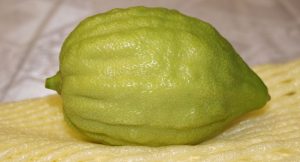
We need to find a better way to understand the symbolism of the minim. We stand with the four minim divided asymmetrically between our two hands. With one hand, we take three of them; the esrog finds prominence in a solo performance in the other. According to Chazal, the esrog deserves the accolades. It combines the admirable features of all the other three. In fact, its very description – פרי עץ הדר, “the fruit of a beautiful tree” – points to its concentration of gifts. Those gifts are all found distributed throughout the other three.
Like the esrog, the lulav is associated with luscious fruit – the dates that grow at the top of the tree. As we hold it in hand, however, we plainly see that it is no competition for the esrog. The esrog tree distinguishes itself in containing in its woody substance the same fragrant material as gives scent to the fruit. This is what makes it a “beautiful tree, according to the Gemara[3] :” its attractive aroma is dispersed through all of it. The lulav may come with a lovely fruit, but it is no “beautiful tree.”
The myrtle is the mirror image of the lulav. Its braided formation of fragrant leaves surrounds a fragrant stem. It bears, however, no fruit. It is “beautiful tree” without the “fruit.”
The simple willow has nothing, really, to put on its brag sheet – no fruit, and no fragrance. It is woody stuff, tree, unaccompanied by fruit or beauty.
The four minim, therefore, can be seen as points on a continuum of desirable traits. At the end of the continuum we find beauty throughout the esrog plant, and in all its aspects. At points along the way, we find the other gifts. Despite the unequal distribution of assets among the four minim, halachah mandates some commonality. To fulfill the mitzvah, each specimen must be תם, and must possess some aspect of הדר. None of the four may be damaged to the point of lacking some of their expected substance. Each one in its own way is a תם, an integrated whole. Each one is also perfect and beautiful in its own right.
The Torah instructs us to “rejoice before Hashem” with the minim. We can stand in His presence without self-consciousness only when we are not tainted by transgression. The taking of the minim must be “for yourselves,” which means that they must fully belong to us, rather than be acquired through theft. The same phrase according to the Gemara also implies that we are to make them entirely ours, not simply borrowed from another person.
Putting all these halachic requirements together, we can see what is taking shape. The minim represent the continuum of berachos that Hashem’s providence provides us. From our standpoint as mortals, we do not see all these berachos as equal. Yet the Torah tells us to take the lot of them, and make each and every one a part of ourselves. Each situation, strength and talent that He grants us can be used constructively to build our personalities. We are to cherish each one, and utilize it to better stand before Him in joy. Whatever Providence offers us, we are instructed to find beauty in it, and to take it and make it fully ours.
Sometimes we recognize the gifts we receive as splendid fruit from a splendid tree, like the esrog. Sometimes, they enable us to stand strong, straight and resolute, like the lulav. That is a good thing, even if it is not accompanied by the glory of producing visible fruit.
At other times, we shine with an inner beauty, like that of the fragrant, plaited leaves of the myrtle. Other times leave us feeling like the willow, which has no beauty, no strength, nothing that endears itself to others. Yet the aravos-moments of our lives are not times of failure. A Mishnah[4] informs us that the lowly willow was put to good use. Its branches were woven together to form inexpensive baskets. With no special feature to recommend its desirability, even this simplest, seemingly least attractive gift from G-d allows us to hold, carry, and preserve.
Whatever kind of day – or life – Hashem orchestrates for us, the lesson of this mitzvah is that we can and must find joy in it. Moreover, we are not simply to react to it, to deal with it, to learn to live with it. Each day, each new kind of experience, offers us nothing less than the stuff with which we build more uplifted and elevated souls.
1.Based on the Hirsch Chumash, Vayikra 23:40
2.Devarim 8:8
3.Sukkah 32B
4.Bikurim 3:8