

A discussion of Halachic topics related to the Parsha of the week. For final rulings, consult your Rav.
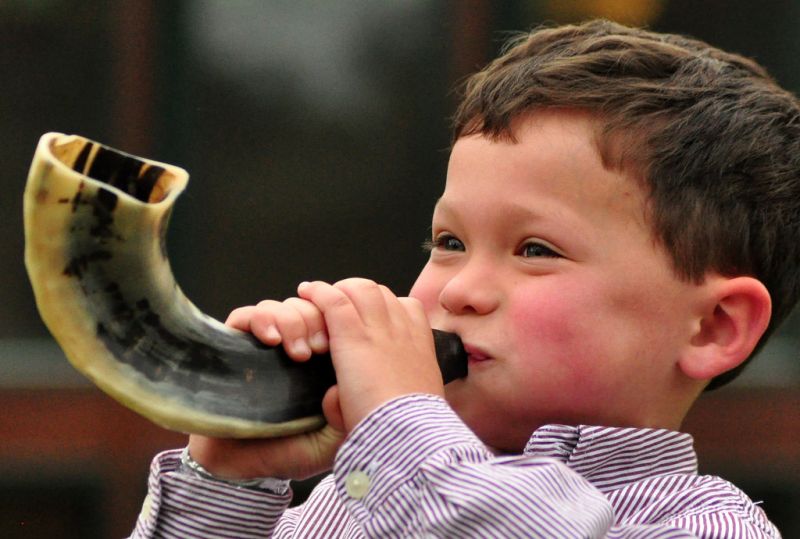
One of the most important mitzvos of Rosh Hashanah is the Biblical command to blow the shofar. Although the significance of this mitzvah has been expounded at length – Rav Sa’adiah Gaon enumerates ten different reasons for blowing shofar(1) – still many people are unfamiliar with the basic procedures involved: how many blasts are sounded, how long or short must they be, etc. While the tokea (the one who blows the shofar) and the makri (the individual who instructs the tokea which blast to sound) must be thoroughly versed in these intricate laws(2) – since it is they who determine if a particular blast was invalid and must be repeated – still it is important for the entire congregation to have some degree of familiarity with the general laws governing this mitzvah.
THE BASIC MITZVAH
The Biblical command is to blow three sets of blasts on Rosh Hashanah. A set of blasts means one teruah sound preceded and followed by a tekiah sound. Thus, the sum total of blasts which one is required to hear on Rosh Hashanah is nine – six tekiah sounds and three teruah sounds.
The tekiah sound was always well defined and agreed upon by all authorities – a long, straight (without a break or pause) blast. The teruah sound, however, was not well understood and the Rabbis were unsure of how, exactly, it was supposed to sound.(3) The Talmud(4) describes three possibilities:
- Three short, straight blasts – what we commonly refer to as shevarim;
- Nine(5) very short, staccato blasts – what we commonly refer to as teruah;
- A combination of both of the above sounds – a shevarim- teruah compound.
To satisfy all of the above opinions, the Rabbis established that the three sets of tekios be blown in three different ways, alternating the teruah sound in each set. Thus we blow tekiah shevarim-teruah tekiah (TaSHRaT) three times; tekiah shevarim tekiah (TaSHaT) three times; and tekiah teruah tekiah (TaRaT) three times. All together that adds up to thirty different blasts: eighteen tekios, three shevarim-teruahs, three shevarim and three teruahs. This is the minimum number of blasts that every adult male is required to hear on Rosh Hashanah. These are called tekios d’myushav, since the congregation is permitted to sit while they are being blown. In practice, however, it is almost universally accepted to stand during these tekios.(6)
[A person who is in dire circumstances (a patient in the hospital, for example) and is unable to hear (or blow) thirty blasts, should try to hear (or blow) ten sounds: one TaSHRaT, one TaSHaT and one TaRaT.(7) No blessing, however, is recited over these blasts.]In addition to these Biblically required blasts, we blow seventy more. Thirty more are blown during Musaf, ten each after the Malchiyos, Zichronos and Shofaros divisions of Shemoneh Esrei. Every adult male is Rabbinically obligated to blow or hear these blasts in their designated places during the Musaf service. They are called tekios d’meumad, since one is required to stand while they are being blown.(8)
Finally, it is customary to blow forty more blasts for a sum total of one hundred blasts. While this custom is based on several early sources(9) and has been almost universally adopted, there are various practices regarding when, exactly, they are blown. Generally, these blasts are blown towards the end of as well as after the Musaf service, and one should refrain from speaking(10) until after all one hundred blasts have been blown.(11)
HOW LONG SHOULD EACH BLAST BE?
The length of a tekiah, both before and after the shevarim or teruah, must be at least as long as the shevarim or teruah which it accompanies.(12) Thus, since it takes about two to three seconds to blow a shevarim or a teruah, the tekiah before and after must be at least two to three seconds long. Since it takes longer than that to blow the combination shevarim-teruah sound, the tekiah which precedes and follows these sounds must be longer as well. Most congregations allot about four or five seconds for each of these tekios. The makri is responsible to keep time.
[It is important to remember that each tekiah must be heard in its entirety no matter how long it takes. If, for example, a tekiah is blown for seven seconds, which is much longer than required, the entire seven seconds’ worth must be heard by the congregation. Care must be taken not to begin reciting the Yehi ratzon until after the blast is concluded.(13)]A teruah is at least nine short blasts (beeps), although in practice, many more beeps are sounded when the teruah is blown. No breath may taken between the short beeps; they must be blown consecutively.
Each shever should be about three teruah-beeps long. B’diavad the shever is valid even if it is only two beeps long, provided that all three shevarim are of that length.(14) No breath may be taken between each shever; they must be blown consecutively.(15)
SHEVARIM – TERUAH -HOW IS IT BLOWN?
There are two views of how to blow the shevarim-terurah combination. Some opinions hold that no breath may be taken between them and even b’diavad, a breath between them invalidates the blast. Others hold that a breath should be taken between the shevarim and the teruah [provided that it takes no longer than the split second that it takes to draw a breath]. The custom in most congregations is to do it both ways; the tekios before Musaf are blown with no breath taken between the shevarim-teruah, while the tekios during and after Musaf are blown with a break for drawing a breath between the shevarim-teruah.(16)
MISTAKES WHILE BLOWING
There are basically two types of mistakes that the tokea can make while blowing shofar. The most common is that the tokea tries but fails to produce the proper sound. The general rule is that the tokea ignores the failed try, takes a breath, and tries again.(17)
The other type of mistake is that the tokea blows the blast properly, but loses track and blows the wrong blast, e.g., instead of shevarim he thinks that a tekiah is in order, or instead of teruah he thinks that a shevarim is due. In that case, it is not sufficient to merely ignore the wrong blast; rather, the tokea must repeat the tekiah that begins this set of tekios.(18)
When a tekiah needs to be repeated, it is proper that the makri notify the congregation (by banging on the bimah, etc.), so that the listeners do not lose track of which blasts are being blown.
ADDITIONAL HIDDURIM
As there are different views and/or stringencies pertaining to various aspects of tekias ha-shofar, one who wishes to be extremely particular in this mitzvah may blow (or hear) additional blasts after Musaf is over in order to satisfy all opinions. These include the following hiddurim:
- There are several ways of blowing the shevarim sound; while some blow short, straight blasts, others make a slight undulation (tu-u-tu).
- Some opinions maintain that l’chatchilah, each shever should be no longer than the length of two beeps.(19)
- Some opinions hold that when the shevarim-teruah sound is blown, there may not be any break at all between them (even if no breath is taken); the last shever must lead directly into the teruah.(20)
- Some authorities insist that the tekiah sound be straight and clear from beginning to end, with no fluctuation of pitch throughout the entire blast.(21)
FOOTNOTES:
1 The most fundamental reason to perform this mitzvah, however, is simply that Hashem commanded us to do so.
2 Mateh Efrayim 585:2.
3 While the basic definition of a teruah is a “crying” sound, it was unclear if that resembled short “wailing” sounds or longer “groaning” sounds.
4 Rosh Hashanah 33b.
5 There are Rishonim who hold that a teruah is three short beeps. B’diavad, we may rely on that view to fulfill our obligation (Mishnah Berurah 590:12).
6 Mishnah Berurah 585:2. A weak or elderly person may lean on a chair or a table during these sets of tekios (Sha’ar ha-Tziyun 585:2).
7 Based on Mishnah Berurah 586:22 and 620:7. See also Mateh Efrayim 586:7 and Ktzei ha-Mateh 590:1. See, however, Mateh Efrayim 593:3, who seems to rule in this case that three TaSHRaTs should be blown.
8 Mishnah Berurah 592:2. B’diavad, one fulfills his obligation if he sat during these tekios; ibid.
9 See Mishnah Berurah 592:4.
10 Asher yatzar, however, may be recited; Minchas Yitzchak 3:44; 4:47.
11 Chayei Adam 141:9.
12 This is based on the minimum length of time required for the teruah, not on the actual time it took to blow a particular teruah.
13 Mishnah Berurah 587:16; Ha-tekios k’Halachah u’Behiddur 1, quoting several sources.
14 Shulchan Aruch Harav 590:7.
15 O.C. 590:4.
16 Mishnah Berurah 590:20 and Sha’ar ha-Tziyun 18. The makri, too, should take a breath between the announcement of shevarim-teruah, so that the tokea will follow his lead (Elef ha-Magen 22).
17 Based on Mishnah Berurah 590:34, Aruch ha-Shulchan 590:20, and Da’as Torah 590:8.
18 Another example is when the tokea mistakenly blows [or begins to blow] two sets of shevarim or teruos in a row. The original tekiah must be repeated.
19 See O.C. 590:3.
20 Avnei Nezer 443; Chazon Ish O.C. 136:1. This is difficult to perform properly.
21 Harav Y.L. Diskin, based on the view of the Ramban and Ritva; see Moadim u’Zemanim 1:5. The Chazon Ish, however, was not particular about this; Orchos Rabbeinu 2:183.
Weekly-Halacha, Copyright © 2001 by Rabbi Neustadt, Dr. Jeffrey Gross and Project Genesis, Inc.
Rabbi Neustadt is the principal of Yavne Teachers’ College in Cleveland, Ohio. He is also the Magid Shiur of a daily Mishna Berurah class at Congregation Shomre Shabbos.
The Weekly-Halacha Series is distributed L’zchus Hayeled Doniel Meir ben Hinda. Weekly sponsorships are available–please send email to the moderator, Dr. Jeffrey Gross [email protected].
The series is distributed by the Harbotzas Torah Division of Congregation Shomre Shabbos, 1801 South Taylor Road, Cleveland Heights, Ohio 44118–HaRav Yisroel Grumer, Marah D’Asra