


The Mitzvah:
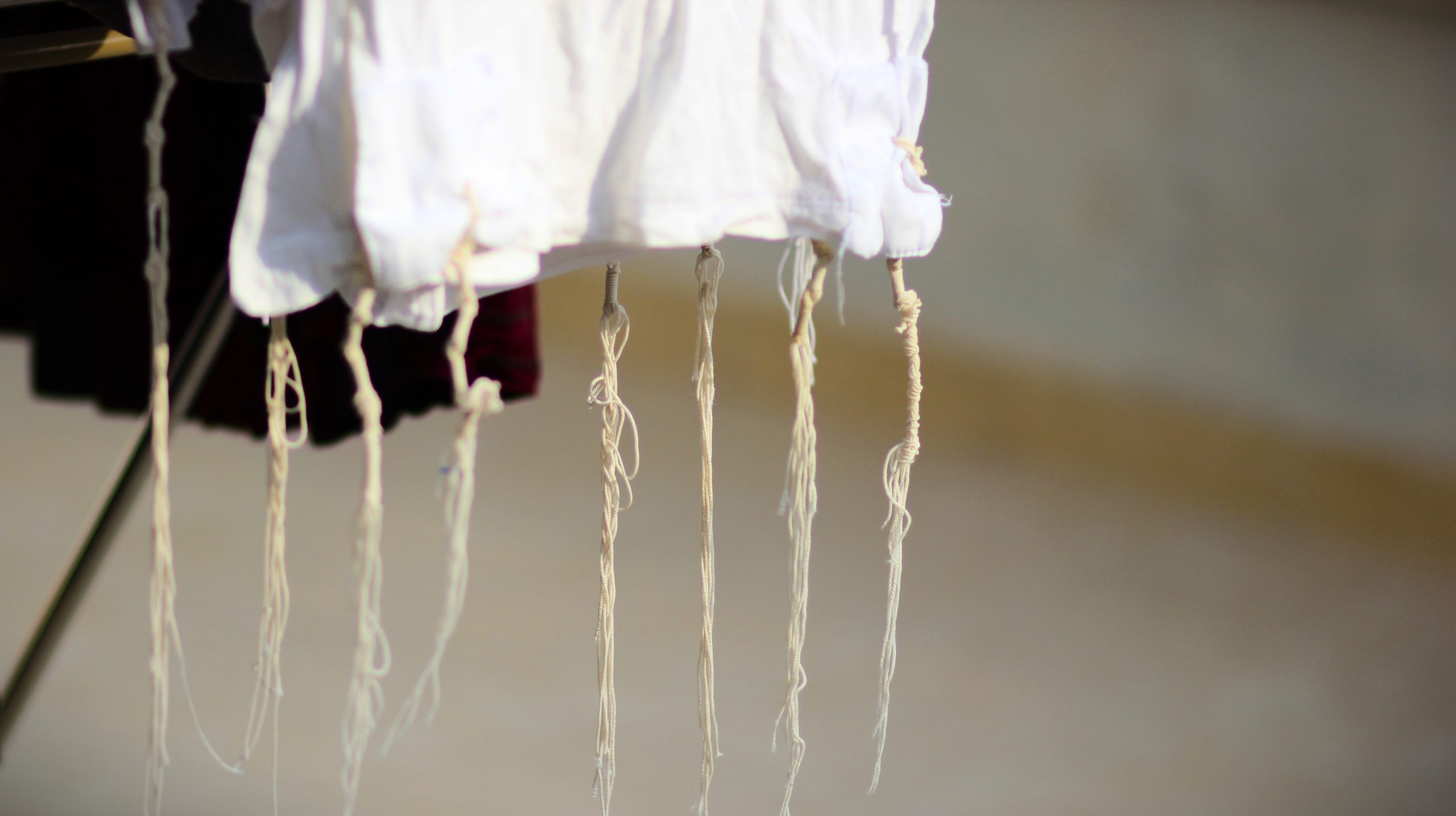
Tzitzis are to be attached to the fringes of a four-cornered garment. Each fringe consists of eight white strings (originally the eighth was called the techeiles that was a specially dyed blue string). (Numbers 15:37-41)
The law requiring tzitzis to be attached to the fringes is specific to the wearing of a four-corner garment. But an object of clothing with two or three corners does not fall under this obligation.
What is it about the “four” fringes which makes it subject to the mitzvah of tzitzis?
Our world, which is composed of multiple creatures, is characterised by the number “four”. Four refers to the “four directions” – north, east, south and west – on a compass wherein the physical world unfolds and operates. It is within this forum of multiplicity that man’s stalwart worship of G-d is to be expressed. Herein all of his diverse energies are to be channelled and harmonized so that he elevates the physical world of “four” so that it is permeated with spirituality.
But “four” is also the symbol of exile – representing journeying into the four directions away from one central and unified point. (The Egyptian exile was for 400 years. The desert-wandering was for 40 years. Both are greater expressions of “four”). Redemption is the return to the original centralized state. It also represents the return to the One Master of the Universe (See Maharal, Gevuros Hashem Ch.23 & Ch.26). As we say in the Amidah, we anxiously await the final redemption in the Messianic era whereupon “the dispersed will be collected from the four corners of the land”.
Tzitzis covers the person’s physical body which resides in the world associated with “four”. The garment is itself “four-cornered”. But from the fringes emerges the strings of the tzitzis.
Tzitzis is a powerful visual tool to live yet to break out of the “four” to attach himself to the Oneness of G-d. Consider the blue dye of the techeiles extracted from the chilazan creature which resembled the color of the seas. The seas, in turn, resemble the heavens that are similar to sapphire and comparable to the Heavenly Throne of Glory (Chullin 89a). Techeiles is relates to the Hebrew word tachlis, “purpose”. Thus, this thread on the fringe – consistent with the message of the tzitzis -is the reminder for man not to lose sight of the overriding “purpose” of life and of creation (Ramban, Numbers 15:32) as he journeys and ascends to the heavens and beyond.
The protruding threads urge man to unify the decentralised “four” by directing his whole being outwards towards the “One” G-d. Thus, he is dissuaded from over-involvement in this world of “four” that constitutes exile, deviation from his national mission, and detachment from G-d.
Instead, the Jew is to see beyond the physical to the symbolism contained within the number “one”. This finds expression in the tzitzis’ sequence of twirls arranged between the five knots: 7, 8, 11 and 13 which, when taken together, equal the numeric sum of the phrase Hashem echad, “G-d is One” (See Shulchan Aruch, Orach Chaim 11:14 & Mishnah Berurah 70). This unity is also seen in the fact that tzitzis is the chosen means to unify all the commandments – to “see it and to remember all the commandments of G-d and perform them”. This is alluded to in the value of tzitzis: (600) which, when added to the 8 threads and 5 knots on each fringe totals 613 – the full number of Torah commandments (Rashi, Numbers 15:39).
Whatever our worldly activities in the world of “four”, the realm of multiplicity, the Jewish man’s objective in life is constant. He has to live a spiritual existence within this physical world so that he successfully merits developing an eternal relationship and “oneness” with G-d. Text Copyright © 2006 by Rabbi Osher Chaim Levene and Torah.org.