

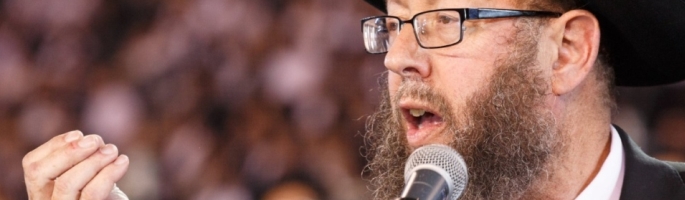

This dvar Torah was adapted from the hashkafa portion of Rabbi Yissocher Frand’s Commuter Chavrusah Tapes on the weekly portion: Tape # 240, An Early Start for Shavuos? Good Shabbos!
The Preface to the Story of the Moshiach
I saw an insight on the book of Rus (which is read on Shavuos), in a commentary called Nachlas Yosef. The second chapter of Rus is quite eventful. The Navi begins by introducing the main players. History is about to occur. Which history? The beginning of the history of the Messiah. We are about to learn of the first meeting between Boaz and Rus — the union that would eventually produce King David, from whom the Moshiach (Messiah) will descend.
Each pasuk [verse] is laden with great symbolism and significance. When Boaz first arrives “on stage,” we learn “Behold, Boaz arrived from Bethlehem. He said to the harvesters, ‘Hashem [G-d] be with you!’ And they answered him ‘May Hashem bless you!’ [Ruth 2:4]”. Why is this exchange of greetings necessary to the plot? If, L’havdil [in extreme contrast], we were writing a play about this great historical event, would it be so crucial to insert the line “And Boaz came in and greeted his workers and asked, ‘How are you?’ and they responded ‘Fine. How are you?'” This does not make for good script! And yet the Navi found it necessary to include this exchange of “Shalom Aleichem” in this historic chapter.
The Talmud [Makkos 23b] adds significance to this event by telling us that they were performing an enactment of the Court of Boaz. Early in Jewish history, it had not been the case that friends would greet each other with the expression “May G-d be with you,” using the ‘real’ name of G-d (rather than the substitute generic name ‘HaShem,’ meaning ‘the Name’). A specific judicial enactment was required to permit this form of greeting. Prior to the time of Boaz people never greeted each other in this way, and subsequent to the time of Boaz we no longer perform this enactment. This was a short- term “emergency” enactment.
What was the reason behind this enactment? At this particular time, the Jewish people were in a sorry state. There was a terrible famine. The times were so bad that a leader of the people, like Elimelech (husband of Naomi) could forsake his people and go off to, of all places, Moav. This was symptomatic of what was wrong with the Jewish people at the time.
What did the “Moetzes Gedolei HaTorah” (Council of Great Torah Sages) of that era decide to do to remedy the situation? They decided that everyone should greet other people with the actual name of G-d. The import of this enactment was that every single Jew is so important and so holy that it is worthy for him to be greeted with none less than the actual name of G-d. This is a whole different way of greeting a person than merely saying “Hi”.
This enactment changed the mood. It reestablished the easily forgotten concept that every person is created in the Image of G-d (Tzelem Elokim). This enactment emphasized, “All Jews are princes” and they deserve to be treated as such. The psychological impact of greeting someone with the Name of G-d had an entirely different meaning than that of just saying hello.
The enactment hammered home the idea that we must be careful of how we treat people. People are not merely intelligent animals. The recognition that people are a b’Tzelem Elokim suggests an entirely different approach as to how to relate to others. This was the enactment of the Court of Boaz.
The Medrash tells us that when our time comes to move on to the next world (after 120 years, G-d willing), we will all be asked two questions: ‘Did you make G-d your King?’ and ‘Did you make your friend your King?’ In other words, did you treat everyone like you would treat the Queen of England, l’Havdil?
A new era was beginning. It called for a new era regarding how we must deal with each other. That is why this chapter is the introduction to the story of the Moshiach. The story of Moshiach must begin with greeting our friends with the Name of G-d, indicating their importance and prestige, indicating that they deserve to be treated like Princes. This, too, must be our preface to the coming of Moshiach so that after 120 years, we will be able to respond in the affirmative to that question ‘Did you anoint your fellow man?’
Technical Assistance by Dovid Hoffman; Yerushalayim.
This week’s write-up is adapted from the hashkafa portion of Rabbi Yissocher Frand’s Commuter Chavrusah Torah Tapes on the weekly Torah portion (# 240). The corresponding halachic portion for this tape is: An Early Start for Shavuos? The other halachic portions for this parsha from the Commuter Chavrusah Series are:
- Tape # 013 – Yerushalayim in Halacha
- Tape # 058 – Yom Tov in Yerushalayim
- Tape # 101 – Teaching Torah to Women
- Tape # 147 – Sefiras HaOmer, Shavuos & the International Dateline
- Tape # 194 – Can One Charge for Teaching Torah
- Tape # 240 – An Early Start for Shavuos?
- Tape # 284 – Birchas HaTorah
- Tape # 330 – Sefer Rus and Its Halachic Implications
- Tape # 374 – Bathing on Shabbos and Yom Tov
- Tape # 418 – Shavuos Issues — Late Ma’ariv / Learning All Night
- Tape # 462 – May A Child Carry A Sefer on Shabbos
- Tape # 506 – Shavuos: Two Days, She’cheyanu, & Other Issues
New! Yad Yechiel Institute is on-line! Visit http://www.yadyechiel.org !For information via email, you may also write to [email protected].
Tapes or a complete catalogue can be ordered from:
Yad Yechiel Institute
PO Box 511
Owings Mills, MD 21117-0511
Call (410) 358-0416 for further information.
Also Available: Mesorah / Artscroll has published a collection of Rabbi Frand’s essays. The book is entitled:
and is available through your local Hebrew book store or from Project Genesis, 1-410-654-1799.