

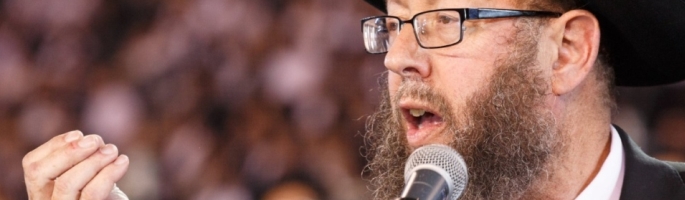

Rabbi Frand on Parshas Tazria-Metzorah
These divrei Torah were adapted from the hashkafa portion of Rabbi Yissocher Frand’s Commuter Chavrusah Tapes on the weekly portion:Tape # 279, Women’s Testimony in Hilchos Niddah.
Good Shabbos!
Two Birds: One For ‘Evil Speech’ and One For ‘Good Speech’
The pasuk [verse] says, “The Kohen shall command and shall take for the person being purified [from the affliction of Tzora’as] two live, pure, birds…” [Vayikra 14:4]. The Zohar cryptically comments that one bird atones for evil speech and one bird atones for good speech.
The Tzora’as that is spoken of in this week’s Parsha is not the physical affliction which is commonly translated as leprosy. Rather, it is a spiritual affliction, which manifests itself in a physical way. Our Sages tell us that the word Metzorah (meaning one who has the disease of Tzora’as) is a contraction of the words “Motzi Rah” [one who spews forth evil], because Tzora’as comes as a punishment for ‘evil speech’ (lashon haRah). However, the Zohar is also informing us that the second bird comes to atone for ‘good speech’. What does this mean?
The Shemen HaTov offers the following explanation. There are two reasons why a person would be afflicted with Tzora’as: for speaking evil and for improperly using the gift of speech. Improperly using the gift of speech means abstaining from uttering “good speech,” when that is called for. Just as speaking gossip can sometimes destroy a marriage, a partnership, or a friendship, so too, sometimes speaking words of encouragement and friendship can take a person who is depressed, lonely and disheartened, and bring him back to life. Sometimes, merely withholding that little compliment, the “Good morning”, the “How are you doing?”, “Thanks”, “Nice Job” can destroy a person. The Zohar is informing us that the sin of Lashon Harah includes both ‘Evil Speech’ and withholding ‘Good Speech’. Sometimes withholding the compliment or the good word can be as destructive as speaking evil.
Perhaps we can expand on this by explaining that these two sins – speaking evil and failing to speak well of someone really stem from the same sin. If we analyze the deeper nature of the sin of Lashon Harah, we discover that these are really two sides of the same coin. If we ever want to discover the root of something in the Torah, an approach to use is to look at the first place that it occurs in the Torah. When we examine what happened in the first place where it is mentioned, we will find the key to understanding what this mitzvah or prohibition is all about.
The first time ‘Lishna Bisha’ [Evil Speech] is found in the Torah, it comes from the Snake. Chava refused the Snake’s suggestion to eat from the Tree of Knowledge, explaining that G-d had forbidden them to eat from it. The Snake dismissed this as a sinister plot on G-d’s part. “G-d knows that when you will eat from that Tree, your eyes will be opened and you will become god-like…” [Bereishis 3:5] Rashi elaborates on the Snake’s argument: “Every professional hates competition. G-d ate from that tree, and then acquired the knowledge to create the world. He is jealous and does not want you to have the same capabilities as Him.
Adam had the best situation imaginable. He was sitting in the Garden of Eden. Angels fed him. Nothing could be better! But then the Snake came and argued – “Nah! It’s not so perfect. You do not have the Tree of Knowledge; you are not god-like!” The Snake looks at a situation that is virtually perfect and finds fault with it. He focuses on the flaw.
This is the essence of Lashon Harah. Lashon Harah is not so much a crime of the mouth. It is a crime of perception. One can look at one’s neighbor and see a nice guy, see talents, see accomplishments, or one can look at the same person and see only his shortcomings and flaws. A person who gravitates to Lashon Harah has a jaundiced eye on the world. The root of this sin is always picking out the bad, rather than the good. The glass is always half empty.
The other classic example of Lashon Harah in the Torah concerns the Spies. They went to Eretz Yisroel. The fruits were huge and delicious. G-d preoccupied everyone with burials so that the spies would not be noticed. What did the spies see? “A land which consumes its inhabitants” [Bamidbar 13:32]. It takes a perverse talent to find the wicked in a virtually idyllic situation.
If that is the case, the Zohar’s reference to ‘Good speech’ and ‘Evil Speech’ are really references to the same thing. The reason why we speak evil about someone is because we fail to see the good in him. We only focus on the negative. Likewise, when we see a person do something nice, and a mere compliment would cause him to feel good, but we cannot be generous enough of spirit to offer that compliment, this is also because of the same jaundiced approach, the inability to see and appreciate the good. Lashon Harah boils down to a stinginess of perception. It is not so much a crime of speech; rather it is a crime of how one perceives the world.
Rabbeinu Yonah (1200-1263) cites the following parable in his Sharei Teshuvah on the pasuk “the foolish person points out the evil, but the straight person sees the positive” [Mishlei 14:9]: Two people walked past a carcass. The carcass was putrid. One person said, “That stench is horrible”; the other person said, “Look how white its teeth are”. Rabbeinu Yonah says that the first person is called foolish and the second person is called straight. The fact that the first person saw the negative does not mean that he is bad, but he is foolish because a person who only focuses on the negative becomes a negative, destructive, and bitter person. A person who speaks Lashon Harah has the strongest negative impact on himself. Forget about righteousness, forget about right and wrong – such a character trait is simply foolish!
Technical Assistance by Dovid Hoffman; Yerushalayim.
This week’s write-up is adapted from the hashkafa portion of Rabbi Yissochar Frand’s Commuter Chavrusah Torah Tapes on the weekly Torah portion (#279). The corresponding halachic portion for this tape is: Women’s Testimony in Hilchos Niddah. The other halachic portions for Parshas Tazria/Metzora from the Commuter Chavrusah Series are:
- Tape # 007 – Self-Defense
- Tape # 051 – Moser: The Dilemma of the Jewish IRS Agent
- Tape # 094 – Hallel on Yom Ha’Atzmaut?
- Tape # 142 – Eyeglasses in Halacha
- Tape # 189 – Mikveh: Tevillah and Chaziza
- Tape # 279 – Women’s Testimony in Hilchos Niddah
- Tape # 325 – The Microscope in Halacha
- Tape # 369 – Bris Millah That Causes Chilul Shabbos
- Tape # 413 – Speaking Lashon Horah on Baalei Machlokes
- Tape # 457 – Getting an Aliyah After Childbirth
- Tape # 501 – Milah and the Sick Baby
- Tape # 545 – Dangerous Medical Procedures
New! Yad Yechiel Institute is on-line! Visit http://www.yadyechiel.org !For information via email, you may also write to [email protected].
Tapes or a complete catalogue can be ordered from:
Yad Yechiel Institute
PO Box 511
Owings Mills, MD 21117-0511
Call (410) 358-0416 for further information.
Also Available: Mesorah / Artscroll has published a collection of Rabbi Frand’s essays. The book is entitled:
and is available through your local Hebrew book store or from Project Genesis, 1-410-654-1799.