

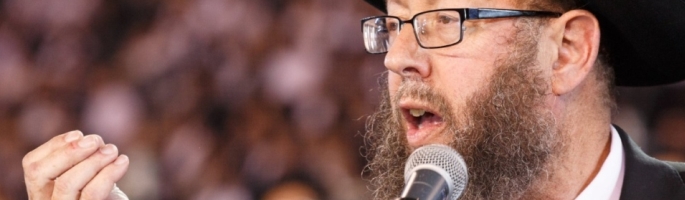

Rabbi Frand on Parshas Beha’aloscha
These divrei Torah were adapted from the hashkafa portion of Rabbi YissocherFrand’s Commuter Chavrusah Tapes on the weekly portion: Tape # 332,Tefilas Tashlumim: Making Up a Missed Davening.
Good Shabbos!
When One Is In Pain He Says “Ouch”
Tosfos in Tractate Kiddushin [37b] says that when the Torah describes Pesach Sheni [the “makeup” Paschal offering], it is actually implying an indictment of the Jewish people for not offering the Korban Pesach during the next 39 years. The fact is that during the next 39 years — after the offering of the Pesach sacrifice that year — they never again offered a Korban Pesach. This was the first and only time they brought a Paschal sacrifice during their 40 years of wandering in the wilderness. The Haftorah of the first day of Pesach [Yehoshua Chapter 5] describes the next time that they offered a Korban Pesach, after they had already entered the Land of Israel.
The Chiddushei HaRim (1799-1866) questions Tosfos’ assertion that this was an indictment of the Jewish people. The reason why they did not offer the Pesach during the years in the wilderness was not because they did notcare about the Korban Pesach. Rather, they did not offer the Korban Pesach for a technical reason. The Halacha requires that everyone who brings a Korban Pesach must be circumcised and all the male members of his family must be circumcised. During the 40 years in the wilderness, they were unable to perform circumcision as a result of the adverse conditions that existed in the desert. Such an operation would have presented a danger to the child.
For forty years, their hands were tied. They were victims of circumstances beyond their control (anusim). This was a technicality. It was not due to callousness or a bad attitude on their part. So why, asks the Chiddushei HaRim, does Tosfos call this an indictment of the Jewish people?
The Chiddushei HaRim answers that the indictment consists of the contrastin attitude, between the people who brought the makeup Pesach that year and all of the Jewish people for the next 39 years.
What happened in the story of the “make-up” Paschal offering? Certain individuals came to Moshe and complained, “We are ritually impure due to contact with the dead. Why should we lose out (lamah nigarah) on the opportunity to bring the Korban Pesach?” [Bamidbar 9:7]
What is the meaning of the question “Lamah Nigarah?” They just explained why they should lose out — because of the technicality that someone who is ritually impure could not bring a Korban Pesach! They were Tameh Mes. That is why they could not bring the Korban Pesach. So what is their question?
The Chiddushei HaRim explains that they were pained by the fact that they were losing out. They understood the technicalities of the Halacha, but they were pleading in desperation “…but what about our spiritual welfare? What is going to be with us? How are we going to manage without being able to bring a Korban Pesach?” They were not challenging the halacha. They were sharing their pain.
The people who brought the make-up Pesach in that second year expressed their anguish at being told that they could not bring the Korban Pesach. Even if one is unable to fulfill a commandment for valid reasons, he should at least feel bad about it.
This was the indictment of the Jewish People. True, for the balance of the 40 years, they could not bring the sacrifice due to halachic technicalities. However, it should have bothered them! It should hurt! The status quo should feel intolerable!
There are many situations in life like this. Nothing can in fact be done, but we can at least feel the pain and anguish at the loss.
When a person wakes up in the middle of the night and stubs his toe while walking around in the dark, he screams. How does screaming help? Clearly, it does not help. But when something hurts, we cry out in pain.
Even if we cannot do anything about our inability to bring a Korban Pesach, we should at least cry about it. We should at least we should have the sensitivity to feel the pain. We should at least say the word ‘ouch!’
The Faithful Servant of G-d Was A Faithful Husband To His Wife
The end of the parsha contains the incident in which Miriam spoke lashon hara [gossip] about her brother Moshe concerning the “Kushite woman that he married” [Bamidbar 12:1]. G-d became angry with Miriam and defended Moshe Rabbeinu with accolades, the likes of which have never been written about any human being in the history of mankind.
There are many varying interpretations regarding the exact nature of Miriam’s complaint concerning the “Kushite woman who Moshe married”. The Moshav Zekeinim m’Baalei HaTosfos has a truly unique way of explaining Miriam’s complaint. He interprets that Miriam argued “it was beneath Moshe’s dignity that he should be married, at this point in his life, to a Midianite woman”.
Moshe was almost 80 years old, was running away, and was stuck in Midianas a ‘fugitive of the law’ when he married Tzipporah. Miriam could understand that under those circumstances he married such a woman. But now he is the greatest person of his generation. Now he must have a better, more worthy, wife for himself. It is simply inappropriate for the leader of the generation to have a foreign woman of unimpressive lineage as his soul-mate.
The Moshav Zekeinim interpolates into the incident that Miriam had told this to Moshe, but he refused to divorce Tzipporah. Moshe told Miriam that he would not divorce his wife for precisely for the factors that Miriam was calling to his attention. “When I was a fugitive and I was a poor penniless shepherd, this woman married me. She stuck by me when I was a nobody. Now that I am the ‘Gadol HaDor,’ the teacher of all Israel, and the master of all prophets, I will not abandon her.
This interpretation, the Moshav Zekeinim suggests, is buttressed by G-d’s testimonial for Moshe “In all My house, he is the most faithful” [Bamidbar 12:7]. Moshe felt a loyalty to the wife of his youth. He possessed the attribute of Hakaras HaTov [recognition the favors done to him] and is unwilling to discard an old wife who might now, in fact, be a less prestigious companion than he could find elsewhere.
We must preface this next remark with a tremendous “L’havdil” (distinguishing between two incomparable situations). Such phenomena do occur many times in the secular world. A person gets married early in life and then becomes very wealthy. He is now a CEO and earns a 7 figure salary. His “old wife” is no longer worthy according to his station in life. So what does he do? He divorces her! It is scandalous. He pays her off, alimony. But that is part of his attitude: “It is OK what I’m doing. I can afford it! I am so rich that I can afford to pay $100,000 a month in alimony.” We hear of this – in one form or another – all too often.
This Moshav Zekeinim is saying that the meaning of G-d’s unprecedented praise for Moshe that “in all My house, he is the most faithful” is that he did not abandon the Midianite wife of his youth, when he “surpassed” her in terms of his station in life. Moshe simply did not think in such terms.
Source For Using “G-d Willing” In Conversation
The Shalo”h (1560-1630) mentions that this week’s parsha contains a source for the custom of using the expressions “G-d willing” (im Yirtzeh HaShem) or “With G-d’s help” (b’Ezras HaShem) in our conversation.
Where do we find such a source? The pasuk says, “Based on the utterance of G-d (al pi HaShem) they camped and based on the utterance of G-d (al piHaShem) they traveled” [Bamidbar 9:23]. The Shalo”h also states regarding the pasuk “The plan of G-d it will come to pass” (Atzas HaShem He Sakum) [Mishlei 19:21] that the word ‘He’ (hay yud aleph) is an acronym (in reverse) for the words “Im Yirtzeh HaShem”.
Of course, everything can be overdone or done to a fault. One can say “Im Yirtzeh HaShem” so much that it loses its effect and can even be said in situations where it sounds ridiculous. But the point that the Shalo”h is making is that one’s conversation can have an effect on a person. If a person uses these expressions and thinks about what he is saying, it helps him realize that ultimately everything is in G-d’s Hands. Verbalizing this and articulating it and making it a mode of regular speech causes a person> to recognize the role of G-d in every day life.
Technical Assistance by Dovid Hoffman; Yerushalayim.
This week’s write-up is adapted from the hashkafa portion of Rabbi Yissocher Frand’s Commuter Chavrusah Torah Tapes on the weekly Torah portion (# 332). The corresponding halachic portion for this tape is: Tefilas Tashlumim: Making Up a Missed Davening. The complete list of halachic portions for this parsha from the Commuter Chavrusah Series are:
- Tape # 015 – Reinstituting the Semicha
- Tape # 060 – Waiting Between Meat and Milk: Adults and Children
- Tape # 103 – The Seven Branched Menorah
- Tape # 149 – Bringing the Sefer Torah to a Temporary Minyan
- Tape # 196 – Vegetarianism
- Tape # 242 – Military Service and Potential Halachic Problems
- Tape # 286 – When Do We Stand In Honor of a Sefer Torah
- Tape # 332 – Tefilas Tashlumim: Making Up a Missed Davening
- Tape # 376 – Davening For A Choleh
- Tape # 420 – Fish and Meat
- Tape # 464 – Honoring Levi’im
- Tape # 508 – The City Of Yericho
- Tape # 552 – Kavod Sefer Torah Vs Kavod Talmid Chochom
New! Yad Yechiel Institute is on-line! Visit http://www.yadyechiel.org !For information via email, you may also write to [email protected].
Tapes or a complete catalogue can be ordered from:
Yad Yechiel Institute
PO Box 511
Owings Mills, MD 21117-0511
Call (410) 358-0416 for further information.
Also Available: Mesorah / Artscroll has published a collection of Rabbi Frand’s essays. The book is entitled:
and is available through your local Hebrew book store or from Project Genesis, 1-410-654-1799.