

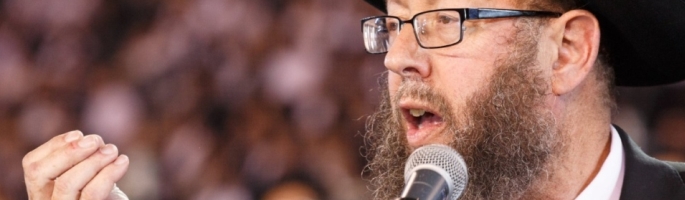

Rabbi Frand on Parshas Behar – Bechukosai
These divrei Torah were adapted from the hashkafa portion of Rabbi Yissocher Frand’s Commuter Chavrusah Torah Tapes on the weekly Torah portion: Tape # 328, Sh’mita and the Heter Mechira.
Good Shabbos!
Aspiring to not be Normal: Holy Fruit Are Consumed by Holy People
Parshas Behar contains the parsha of the Shmita [Sabbatical] year. Shmita is a mind-boggling concept. Shmita teaches us that an apple that grows in the Land of Israel has holiness. An Esrog that grows in the Shmita year has holiness. We generally think of holiness in terms of a Torah scroll which has G-d’s Name written therein. An animal acquires holiness if it is dedicated to G-d. However, we (who are outside of Israel) do not usually encounter the concept of fruits, vegetables and grains that have holiness. Such is the power of the Land of Israel. Eretz Yisroel is a different land. Wheat that grows there is different wheat!
Rav Mordechai Gifter (1916-2001) related an incident involving the Ponevezer Rav (1886-1969). In a Shmita year, the Ponevezer Rav went over to a tree, kissed the tree and said “Good Shabbos to you”. Just like there is a special day – Shabbos — on which we have to feel special, so too in Eretz Yisroel during the Shmita year, it is Shabbos for the land.
Several years ago, I recall listening to “All Things Considered” on National Public Radio. To commemorate the signing of the then-recent Peace Accords, there was a segment about Israel in general. It was a piece about the difference between Tel Aviv and Jerusalem. This program reminded me of the concept that Eretz Yisroel is not a normal land.
What is the difference between Tel Aviv and Jerusalem? They interviewed several people. The thrust of the responses was that Tel Aviv is a “normal city”. Tel Aviv is a pragmatic city. “It is a city which is unencumbered by history. Tel Aviv is like Miami!”
Jerusalem is not Miami. Jerusalem is not pragmatic. Jerusalem is not “normal”. Jerusalem is “encumbered by history” – thousands of years of history that the city must bear on its shoulders.
They contrasted the differences between a Friday afternoon in Tel Aviv and a Friday afternoon in Jerusalem. They had excerpts of the sounds of Tel Aviv: teenagers listening to ‘Rap music’. They commented “this is so normal”. A person on the street Friday afternoon in Tel Aviv could shut his eyes and just listen to the music and think he was in downtown Baltimore. Tel Aviv is ‘normal’.
On the other hand, “the Orthodox Jews, many of them dressed in the broad brimmed hats and the long caftans, are scurrying through the streets of Jerusalem trying to prepare for the upcoming Sabbath”. Tel Aviv is “normal”. Jerusalem is “abnormal”.
This is saying that the wish of many Israelis has been achieved. The wish of many of them has been “let us be like all the nations” [Samuel I 8:20]. We just want to be “normal”. We do not want to have this burden of history, this burden of theology, this burden of Judaism. We want to be normal.
They fail to realize — and this is sad to say what is happening — that if the goal in life is that Tel Aviv should be like Miami, then it makes more sense to just go to Miami. If the goal is to imitate Miami, where one can find drugs and vice 24 hours a day and there is no need to worry about history — then why shouldn’t they just go to the real one?
In fact, many of them are leaving. Rabbi Emanuel Feldman, who now spends most of his time in Jerusalem, recently wrote the following:
They abandoned the Kibbutz in droves, physically and spiritually, for the less austere life and ultimately the greater comforts and the material opportunities of Canada and the United States. The most sacred tenet of secular Zionist canon – settling in Israel – is utterly ignored. As the secularists painfully know, ‘Yerida’ from Israel is primarily a secular phenomenon while ‘Aliya’ to Eretz Yisroel is primarily Orthodox.
According to conservative estimates, there are close to a half million former Israelis now living in the West. That is to say that while those raised on a religion-less diet abandon Israel for the West, those raised on Mitzvah observance apparently do not find it difficult to abandon the luxuries of the West for a less comfortable life in Israel. This has resulted in the following anomaly: Hebrew spoken in American electronic stores on 42nd street in New York and on Pico Boulevard in Los Angeles, while English is spoken in Israeli Yeshivos like Kerem B’Yavneh and Brisk. The Orthodox in Israel, whether they are Chassidim, Charedim, Sephardim, or Kippot Serugot ask a troubling question of the secularists. Who today, are the real ‘Lovers of Zion’? That is the real irony of ironies. Who are the ‘Zionists’ today? Who are the ‘Chovevei Tsion’? It is those who observe Torah and Mitzvos. Those are the real Zionists. Those are the people that are willing to live in an ‘abnormal’ land.
This is what we must understand about Eretz Yisroel. It is in fact NOT normal. It is not normal that when an apple grows, I must consider all types of ritual considerations regarding how to treat the apple. It is not normal, but that is what Eretz Yisroel is all about. This is what being a Jew is all about. A Jew is encumbered with history. He is encumbered with theology. If one fails to realize and appreciate that, there is really no reason to live in Eretz Yisroel.
There was a recent article in the New York Times that noted that the secular Israelis look upon the immigrants (olim) who come from the United States to Israel as if they are crazy. In their view, there is no sane person that is living in the United States and has a livelihood in the United States and a house in the United States who gives it up for living in Israel. They feel that anyone who makes Aliyah from the United States nowadays must be out of his mind.
In a sense these secular Israelis are right. It does take people who are not ‘normal’ to live in a Land that is not ‘normal’. But this non- normalcy is something that we must admire and something to which we must aspire. People who are willing to give up the lap of luxury to fulfill a mitzvah – those people can live in a land where apples and grapefruits are holy.
Technical Assistance by Dovid Hoffman; Yerushalayim.
This write-up is adapted from the hashkafa portion of Rabbi Yissocher Frand’s Commuter Chavrusah Torah Tapes on the weekly Torah Portion. The halachic topics covered for the current week’s portion in this series are:
- Tape # 011 – Rationing Medical Care
- Tape # 012 – Can Teachers Strike?
- Tape # 054 – Life Insurance: The Torah Policy
- Tape # 055 – Candle Lighting & Havdalah: How Early & How Late?
- Tape # 097 – “Ribis” Problems of Interest for the Jew in a Mercantile Society
- Tape # 098 – “Cheremei Tzibur”: A Ban on Living in Germany?
- Tape # 145 – Kidney Donations: Endangering Oneself to Save Another
- Tape # 192 – Making Shabbos Early
- Tape # 282 – The Physician’s Obligation to Heal
- Tape # 328 – Sh’mita and the Heter Mechira
- Tape # 372 – Using Shuls As A Shortcut
- Tape # 416 – Supporting Jewish Merchants
- Tape # 460 – The Obligation of Checking One’s Teffilin
- Tape # 504 – Lag B’Omer
- Tape # 548 – Marrying for Money
New! Yad Yechiel Institute is on-line! Visit http://www.yadyechiel.org !For information via email, you may also write to [email protected].
Tapes or a complete catalogue can be ordered from:
Yad Yechiel Institute
PO Box 511
Owings Mills, MD 21117-0511
Call (410) 358-0416 for further information.
Also Available: Mesorah / Artscroll has published a collection of Rabbi Frand’s essays. The book is entitled:
and is available through your local Hebrew book store or from Project Genesis, 1-410-654-1799.