

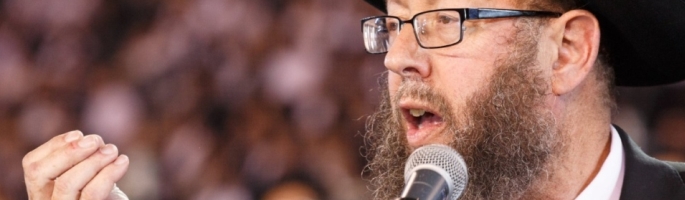

Rabbi Frand on Parshas Chukas-Balak
These divrei Torah were adapted from the hashkafa portion of Rabbi Yissocher Frand’s Commuter Chavrusah Tapes on the weekly portion: Tape #423, The Tefilah of a Tzadik for a Choleh. Good Shabbos!
There Are None So Blind As Those Who Will Not See
In Parshas Chukas we read about a very upsetting incident — the sin of the “Waters of Contention” (Mei Merivah), concerning which we are taught that Moshe and Aharon did something “wrong” commensurate to their lofty stature. The pasuk says: Hashem said to Moshe and to Aharon, “Because you did not believe in Me to sanctify Me in the eyes of the Children of Israel, therefore you will not bring this congregation to the Land that I have given them.” [Bamidbar 20:12]. This is an example of G-d being exacting in his expectation of the righteous — like the width of a hair’s breadth [Bava Kamma 50a].
One of the most moving narratives in the Torah is contained in the Torah reading that we read on Simchas Torah. We complete the Torah and read the last 8 pasukim, beginning with the words “And Moshe died there…” [Devorim 34:5]. We know how much Moshe wanted to go into Eretz Yisrael and we empathize with how difficult it was for Moshe to be denied this last request because of the minute little slip that happened in Parshas Chukas by the incident of Mei Merivah.
There are a dozen or more different interpretations as to what exactly Moshe and Aharon did wrong. The Ramba”n cites an interesting interpretation in the name of Rabbeinu Chananel. The sin was that Moshe said, “Shall ‘We’ bring forth for you water from this rock?” [Bamidbar 20:10]. Rabbeinu Chananel focuses on the use of the first person plural and suggests that people might be mislead and think that it was by virtue of their own powers that Moshe and Aharon would bring forth water from the rock. Moshe should have said, according to Rabbeinu Chananel, “Will ‘He’ bring forth for you water from this rock?”
They were punished for this slight error in grammatical inference, which might cause people to think that Moshe and Aharon were more than just intermediaries, and that it was not necessarily G-d who was ‘calling the shots’. That is the sin of Mei Merivah according to Rabbeinu Chananel.
Rav Simcha Zissel Brody (Rosh Yeshiva of the ‘Chevron’ Yeshiva) observed the following: What is the context here? Rashi cites the teaching of Chazal that this was one of the miraculous situations where a small geographical space held a large multitude of people. The whole incident was clearly miraculous from start to finish. Over 2 million people were surrounding the rock and staring at it ‘face to face’. Such a phenomenon is patently impossible through normal rules of nature. The gushing flow of the water from the rock certainly defied the laws of physics. Even if the rock had been hollow, more water emerged from it than it would ever be capable of holding. The whole context and environment of everything that occurred during this incident screams out ‘Nes!’ [MIRACLE!]
So what is Rabbeinu Chananel suggesting? Could someone have thought to say “this was accomplished by Moshe Rabbeinu, not by G-d”? How could anyone be so blind?
The answer is that people who want to be blind and who want to deny miracles have the ability to do so in the face of overwhelming evidence. We see this throughout history. There are situations that the Jewish people have experienced, which defy rational explanation. Even in our own time, in our own days, we have seen it! The ONLY rational explanation is that they were miracles from Heaven!
We do not even need to go back to the miraculous Six-Day War. We can go back to the (first) Gulf War when only 3 people were killed by dozens of Scud rockets aimed at Eretz Yisrael. This was an open miracle. And yet, the entire population there did not become Ba’alei Teshuvah [repentant]. There are never shortages of ‘explanations’ for how it could have happened or why it happened. The whole situation can cry out Nes! Nes! Nes! But people who want to deny will find ways to deny.
This is the practical lesson of Rabbeinu Chananel’s interpretation. There are none so blind as those who will not see.
A Lesson In Scrutiny
Rav Mordechai Gifter made an interesting point regarding the variety of disparate interpretations given by the commentaries to the ‘sin’ of Mei Merivah. At first glance, the situation seems quite innocuous. On the surface, it seems that Moshe Rabbeinu did not do anything wrong. But what emerges from all the interpretations is that when analyzing an act with a microscope from every single angle, it is not hard to find many ‘imperfections’ in the act, even an act done by the likes of Moshe Rabbeinu.
If, Rav Gifter pointed out, it is so easy to come up with such a long laundry list of ‘crimes’ committed by Moshe in this seemingly brief and innocuous incident, what can be said about our own actions? Sometimes when things ‘go wrong’ for us, we start asking theological questions: “I’m such a good guy. Why are these things happening to me? What did I do wrong?”
The lesson is that if Moshe’s one act could be so laden with “possibly wrong nuances,” there is certainly room to scrutinize our own actions. Actions that we even think to be ‘mitzvos’ — might sometimes fall far short of pristine acts of nobility.
This is the basis of the Rabbinic statement “If one sees punishment befalling him, he should scrutinize his actions” (ye-fash-pesh b’ma-sav) [Brochos 5a]. Unfortunately, we sometimes look at our behavior superficially and conclude, “I still do not understand what I am doing wrong”. We should scrutinize our own actions in the same fashion that the Torah commentaries scrutinize the incident of Mei Merivah to determine the basis of Moshe’s punishment. Then we will perhaps find that our deeds are not as perfect as we would like to think.
It All Stems From The Same Source
The parsha contains the plague of the attack of snakes [Bamidbar 21:8]. In order to stop the plague, Moshe was told “Make for yourself a serpent and place it upon a flagpole”. The antidote for the attack by snakes was to fashion a copper serpent and place it atop a banner. Anyone who was bitten by the snake would look at the banner and become healed.
Rav Chaim Shmuelevitz notes the irony of the fact that the cure for the snake bites should itself be a snake. It would be more logical to put the opposite thing on the banner — a vial of anti-snake serum or anti-poison serum. One would think that the last thing in the world that would be effective as a cure would be a snake itself!
What is the symbolism of the fact that the cause of the problem is itself the item to look at in order to cure the problem?
Rav Chaim Shmuelevitz answers that when a person becomes angry with someone, he may yell at or strike him. On the other hand when we love someone, we kiss or embrace the person. These two different emotions — anger and love – – engender two different manifestations. With G-d, on the other hand, everything is from the same source. When He punishes us, it is not out of anger. It is either in order for us to grow from the experience or in order for the experience to atone for us, or in order to test us in some way. Whatever the explanation, G-d never acts out of spite or anger. Therefore, the same source for the pain can be the source for the cure. The snake caused the pain and the same snake can cause the cure because even the ‘pain’ was a form of G-d’s love.
“For as a father disciplines his children, this is how the L-rd disciplines you.” [Devorim 8:5] When a father disciplines his children, it should never be out of anger. Discipline should always serve the purpose of the child’s need to rectify him or her self.
Therefore, it is perfectly legitimate that the same snake that killed can be the snake that brings life. It all comes from the same source of love and concern for His children.
Technical Assistance by Dovid Hoffman; Yerushalayim.
This week’s write-up is adapted from the hashkafa portion of Rabbi Yissocher Frand’s Commuter Chavrusah Torah Tapes on the weekly Torah portion (# 423). The corresponding halachic portion for this tape is: The Tefilah of a Tzadik for a Choleh. The complete list of halachic portions for this parsha from the Commuter Chavrusah Series are:
- Tape # 018 — Rending Garments on Seeing Yerushalayim
- Tape # 063 — Intermarriage
- Tape # 107 — Rabbonim and Roshei Yeshiva — Do Sons Inherit?
- Tape # 152 — Halachic Considerations of Transplanted Organs
- Tape # 199 — Stam Yeinam: Non Kosher Wines
- Tape # 245 — Skin Grafts
- Tape # 335 — Postponing a Funeral
- Tape # 379 — The Jewish “Shabbos Goy”
- Tape # 423 — Tefilah of a Tzadik for a Choleh
- Tape # 467 — Detached Limbs and Tumah
- Tape # 511 — Autopsies and Insurance
- Tape # 555 — Women Fasting on 17th of Tamuz, Tisha B’Av and Yom Kippur
New! Yad Yechiel Institute is on-line! Visit http://www.yadyechiel.org ! For information via email, you may also write to [email protected].
Tapes or a complete catalogue can be ordered from:
Yad Yechiel Institute
PO Box 511
Owings Mills, MD 21117-0511
Call (410) 358-0416 for further information.
Also Available: Mesorah / Artscroll has published a collection of Rabbi Frand’s essays. The book is entitled:
and is available through your local Hebrew book store or from Project Genesis, 1-410-654-1799.