

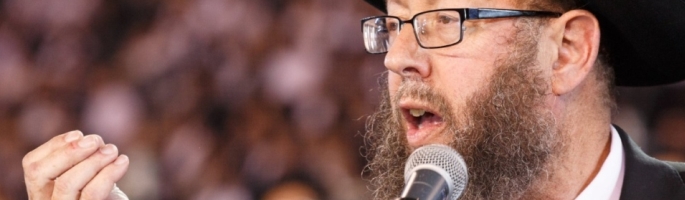

These divrei Torah were adapted from the hashkafa portion of Rabbi Yissocher Frand’s Commuter Chavrusah Tapes on the weekly portion: Tape #437 Accepting Tzedaka from Women. Good Shabbos!
Who Cares About The Scoffers of the Generation?
At the beginning of the Parsha, Rashi cites a Medrash. The Medrash says that the scoffers of the generation mocked Avraham and Sarah, and said that Sarah became pregnant when she was in the house of Avimelech. They said that Avraham was not Yitzchak’s biological father. To counteract this cynical suggestion, G-d miraculously made Yitzchak’s appearance exactly like Avraham’s. He was a replica. Everyone who saw the child immediately testified: “Avraham fathered Yitzchak” [Bereishis 25:19].
Many commentaries wonder why it was necessary for G-d to make a miracle, just to counteract the words of the scoffers of the generation (leitzanei haDor). Who cares what the leitzanei haDor say?
Rav Gifter, zt”l, Rosh Hayeshiva of the Telshe Yeshiva, once said that we learn about the destructive power of cynicism from this Medrash. Leitzanus is a terrible plague. A “Leitz” (one who speaks “leitzanus”) is not to be confused with a person who has a good sense of humor or even a sharp wit. Humor is not leitzanus. Leitzanus has a connotation of cynicism. It refers to taking everything which is high and knocking it down. A leitz takes everything that is holy and tries to demonstrate the profane side of it.
The Mesilas Yesharim writes that in the military, they could prevent an incoming arrow from penetrating a protective shield by covering the shield with a slimy substance. In this way, the arrows bounced or slid right off the shield and were unable to penetrate the metal. Likewise, he writes, mussar is intended to be an arrow that will penetrate a person’s heart and motivate him to repent. However, a single cynical comment can push away a hundred rebukes. One “good line” that cynically mocks a mussar lecture deflects incoming arrows of rebuke intended to soften the heart of the listener, just as the slime that covers the battlefield shields deflects the incoming arrows of attack. We have to be extremely careful, writes the Mesilas Yesharim, not to fall into the trap of cynicism.
This is why the miracle of the facial appearance of Yitzchak was necessary. The leitzanei haDor cannot just be discounted. People like that have an effect. G-d wanted to show that this was the future of Klal Yisrael. A lot was riding on the integrity of the authentic father-son transmission between Avraham and Yitzchak. The few leitzanei haDor had the potential to ruin it all with their one-liners and their snide remarks. It was so important that this not happen, that G-d changed nature to create an exact duplicate of Avraham’s appearance, in the appearance of his son, Yitzchak.
It is my observation that we as parents as a generation are raising very cynical offspring. Every kid thinks he is a comedian. Every kid thinks he has to come up with a ‘line’. The trouble is that when a person starts to mock one thing and then starts to mock another thing all too often he is left with nothing that is sacred.
The mode of leitzanus can be very entrapping. Once one goes down that path, it is hard to emerge with respect for anything. It is a terrible plague in our time. I am not sure what it comes from. Most likely it results from society at large thriving on cynicism. If one turns on the radio all one hears is cynicism, putting down one’s opponents, and mocking. It pervades the airwaves and it pervades society.
We should be careful not to fall into the ensnaring web of cynicism that exists out there. It is a destructive force. Once one is always trying to put down, to one-up, to reject anything that comes his way he is left with nothing.
It was worth it for the Almighty to perform an open miracle to protect the lesson of “Avraham fathered Yitzchak” from the scoffers of the generation.
Hopefully I Will Be Caught In The Act
The Gemara [Makkos 24a] says that the expression in Tehillim [15:3] “who has no slander on his tongue” refers to Yaakov. The proof cited by the Gemara that Yaakov Avinu was the paradigm of the man of truth is the pasuk [verse] in our parsha: “Perhaps my father will feel me (Ulai yemushainee avi) and I will be as a mocker in his eyes” [Bereishis 27:12].
This Gemara requires explanation. Of all places in Chumash, the least likely place we would expect to bring a proof of Yaakov’s honesty is from the incident when he disguised himself as Eisav! The proof that we would have expected is Yaakov’s speech to Lavan, in which he said that he never cheated during all his years of service [Bereishis 31:38-41]: “These twenty years I have been with you, your ewes and she goats never miscarried, nor did I eat rams of your flock. That which was mangled I never brought you I myself would bear the loss, from me you would exact it, whether it was stolen by day or stolen by night… By day scorching heat consumed me, and frost by night; my sleep drifted from my eyes…” However, we would not think that Yaakov’s finest hour was his masquerading as Eisav to receive the blessings.
I saw a beautiful response to this question from Rav Simcha Zissel Ziv (1824-1898). We see from the Targum Yonasan ben Uziel’s translation of the expression “Perhaps my father will feel me,” that Yaakov was not worried that he would incur the wrath of his father. He was not worried that Yitzchok would curse him for his misrepresentation. He was guaranteed protection from any such curse because his mother had assured him “Your curse will be upon me, my son” [Bereishis 27:13]. He was worried about the sin of falsehood. The idea of lying was so abhorrent to Yaakov that he was petrified of carrying out his mother’s suggestion.
Rav Simcha Zissel explains how the Targum inferred this from the pasuk in Chumash. Rav Simcha Zissel explains it based on a teaching of the Vilna Gaon in last week’s parsha.
Our Sages teach that when Eliezer told Avraham “Ulai” (Maybe) the woman will not wish to come with me, he was really thinking “Elai” (to me) – meaning then perhaps Yitzchak will marry my daughter. The Gaon asked why Chazal take Eliezer’s innocuous remark and make something sinister out of it. The Goan explains that there are two words in Hebrew that connote “maybe” “Ulai” and “Pen”. What is the difference? The Gaon answers that when we do not desire the possible outcome to occur we use the word “Pen” as in “Pen namus (lest we die)” [Shemos 20:16]. This is the type of “maybe” that a person does not want to occur. The connotation of the word “ulai” is that I DO want it to happen. Since Eliezer said “Ulai” – that the woman won’t want to come – we see that deep down he really did not want her to come (so that he could become Yitzchak’s father-in-law).
Based on the Gaon’s principle that “ulai” means I want that particular result to happen, Rav Simcha Zissel explains that when Yaakov says “ulai” my father will touch me, the connotation is that he wants that to happen. Yaakov wants to be “caught in the act.” Why would Yaakov want to be discovered? The answer, Rav Simcha Zissel says is that Yaakov wants to be discovered because he abhors falsehood so much that he would rather be discovered and not receive the blessings than to be deceitful, even if it would allow him to receive the blessings.
That is why this pasuk, more than any other, highlights the honesty of Yaakov. He had no choice in the matter. He was following his mother’s orders. It was essential that he receive the blessings. But he hated falsehood. He hated it so much that he says “Ulai” my father will touch me, hoping that in fact this would occur.
Transcribed by David Twersky; Seattle, WA [email protected] Technical Assistance by Dovid Hoffman; Baltimore, MD [email protected]
This write-up was adapted from the hashkafa portion of Rabbi Yissocher Frand’s Commuter Chavrusah Torah Tape series on the weekly Torah portion. The complete list of halachic topics covered in this series for Parshas Toldos Sarah are provided below:
Tapes or a complete catalogue can be ordered from the Yad Yechiel Institute, PO Box 511, Owings Mills MD 21117-0511. Call (410) 358-0416 or e-mail [email protected] or visit http://www.yadyechiel.org/ for further information.
Text Copyright © 2004 by Rabbi Yissocher Frand and Torah.org.
Transcribed by David Twersky; Seattle, Washington.
Technical Assistance by Dovid Hoffman; Yerushalayim.