

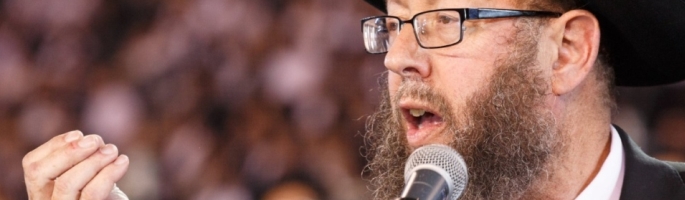

Rabbi Frand on Parshas Behar-Bechukosai
These divrei Torah were adapted from the hashkafa portion of Rabbi Yissocher Frand’s Commuter Chavrusah Torah Tapes on the weekly Torah portion: Tape # 11, Rationing Medical Care. Good Shabbos!
Make Peace and Greet Moshiach
Parshas Bechukosai contains words of blessing and words of rebuke. The Parsha begins with the message that the world is set up, such that, if the Jewish people keep G-d’s mitzvos, blessings will come automatically. Rains will fall at the most convenient of times, and the Jewish people will be able to rest securely in their land.
The Toras Kohanim on this pasuk [verse] asks, “Does this mean we will only dwell securely in Eretz Yisroel, but not in Chutz L’Aretz [outside the land of Israel]? What does this mean — we do have food and drink?” The Toras Kohanim answers that if there is no peace, there is nothing. As long as we are living in exile under a foreign government, there is no Shalom. Without Shalom there is nothing. The Toras Kohanim says that Shalom is equivalent to everything, as we say in our prayers, “He Makes Shalom and Creates Everything”.
As we all know, without Shalom — Shalom in a community or Shalom in a family — Shalom between communities and between nations, nothing has any worth. This is not just a Toras Kohanim, this is a Mishneh — the last Mishneh in Shas [Uktzin 3:12]. “The Holy One, Blessed be He, found no vessel to hold Blessing for Israel other than (the vessel of) Peace.”
The Kesav Sofer explains, that when there is no peace, it is usually because people are jealous of their neighbors. When people are constantly comparing themselves to the Joneses or the Goldbergs or the Cohens, then they will never be happy. People will never be satisfied, no matter how many blessings, and no matter how much food and drink they have. If one is being eaten up by that “cancer” which is called kin’ah [jealousy], then he will never ever have an appreciation for what he possess. Therefore, there is no vessel which can hold the blessings — other than the vessel of peace.
Today, we have in Klal Yisroel a lack of Shalom, even, unfortunately, among our own people. And if we are lacking Shalom, we cannot appreciate our blessings.
In 1980, Rav Yaakov Kamenetsky traveled to the Knessiah Gedolah (of Agudath Israel) in Jerusalem. At that particular time in his life, Rav Yaakov felt extremely weak. Rav Yaakov did not feel that he was physically up to making the trip to Eretz Yisroel. But, Rav Yaakov’s arm was twisted, he was prevailed upon, and he made the trip. [He was so concerned about his health, that he felt he would not make it back home. He even left word that if he were to die in Eretz Yisroel, he wanted to be buried there, of course.]
Because of his physical condition, Rav Yaakov did not travel around much, nor did he give shiurim, while in Eretz Yisroel. However, Rav Yaakov said, “I want to go to one Yeshiva — I want to go to Yeshivas Kol Yaakov.” Rav Yaakov was taken to this Yeshiva and he got up to speak. Rav Yaakov was crying as he told the students, “My entire life I wanted to great Moshiach. I now feel that I won’t have this merit; I don’t feel that I’ll live much longer. But, if I can’t greet Moshiach, at least I want to be among a group of people that I know for sure, will be among those who greet Moshiach. I know that this Yeshiva will be among those that will greet him.”
What was so special about this Yeshiva? Did they know Shas by heart? In Kol Yaakov, is everyone careful to be on time when davening [daily prayer] starts? Not necessarily. This Yeshiva was so special because they make peace between Ashkenazic and Sephardic bochrim. It was one Yeshiva that had both students of European-Russian descent and of Spanish-Turkish-North African descent and they made Shalom between these two (sometimes at odds) segments of the Jewish people.
We must take this advice from Rav Yaakov. If we want a Segulah [a treasure (used in the context of having special merit)] that we will be from those who greet Moshiach, we must take action to make Shalom — between husband and wife; between man and his fellow; between Chassidim and Misnagdim. Make Shalom, and, Rav Yaakov says, be among those who greet Moshiach.
This write-up is adapted from the hashkafa portion of Rabbi Yissocher Frand’s Commuter Chavrusah Torah Tapes on the weekly Torah Portion. The halachic topics covered for the current week’s portion in this series are:
Tape # 011 – Rationing Medical Care
Tape # 012 – Can Teachers Strike?
Tape # 054 – Life Insurance: The Torah Policy
Tape # 055 – Candle Lighting & Havdalah: How Early & How Late?
Tape # 097 – “Ribis” Problems of Interest for the Jew in a Mercantile Society
Tape # 098 – “Cheremei Tzibur”: A Ban on Living in Germany?
Tape # 145 – Kidney Donations: Endangering Oneself to Save Another
Tape # 192 – Making Shabbos Early
Tape # 282 – The Physician’s Obligation to Heal
Tape # 328 – Sh’mita and the Heter Mechira
Tape # 372 – Using Shuls As A Shortcut
Tape # 416 – Supporting Jewish Merchants
Tape # 460 – The Obligation of Checking One’s Teffilin
Tape # 504 – Lag B’Omer
Tape # 548 – Marrying for Money
Tape # 592 – Ribis and the Non-Jew
Tape # 636 – The Kedusha of the Ezras Noshim
Tape # 680 – Is Ribis Ever Permitted?
Tape # 724 – The Chazzan Who Changes His Mind
Tape # 768 – Dos and Don’ts of Treating a Lender
Tapes or a complete catalogue can be ordered from the Yad Yechiel Institute, PO Box 511, Owings Mills MD 21117-0511. Call (410) 358-0416 or e-mail [email protected] or visit http://www.yadyechiel.org/ for further information.
Text Copyright © 2006 by Rabbi Yissocher Frand and Torah.org.
Transcribed by David Twersky; Seattle, Washington.
Technical Assistance by Dovid Hoffman; Yerushalayim.