

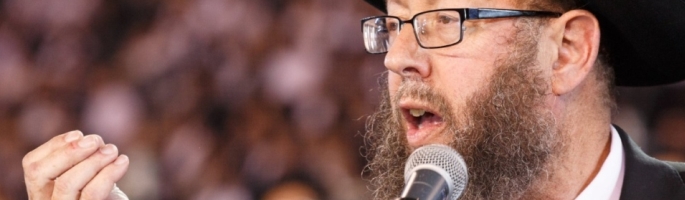

These divrei Torah were adapted from the hashkafa portion of Rabbi Yissocher Frand’s Commuter Chavrusah Tapes on the weekly portion: Tape # 490, The Lefty and Tefillin. Good Shabbos!
We Cannot Tolerate A Chillul HaShem – Even For A Minute
The Torah teaches, “And Moshe said: ‘So Said Hashem – At about midnight I shall go out in the midst of Egypt…'” [Shemos 11:4]. Rashi comments on the strange prefix “K’chatzos laylah” [at ABOUT midnight]. Of course, the Almighty has the ability to be meticulously precise. Why then was the time of the Firstborn Plague approximated? Rashi explains that Hashem had in fact been precise in his message to Moshe, telling Moshe that the plague would strike at EXACTLY midnight. However, Moshe modified the message so that the Egyptian astrologers who would not be able to pinpoint the moment should not think (if midnight — according to their calculation — passed without any plague) that Moshe was a liar.
In past years, we have asked the following question: Moshe Rabbeinu already had a perfect record predicting specific supernatural plagues during a period extending back over 12 months in time. He has never been wrong. So why is there concern that if when the tenth plague occurs, the astrologers may think that it occurred two minutes earlier or later than the designated time? That certainly would not give them any basis for labeling Moshe a faker or liar!
In past years we have explained that it in fact would have given them the basis for labeling Moshe a liar, for that is the corrosive nature of “leitzanus” [scoffing]. The power of cynicism is to undermine obvious truths and incontrovertible facts with skepticism — sowing seeds of doubt.
This year, I came across a different approach to this question from Rav Elya Meir Bloch. According to Rav Bloch’s approach, we are not worried about the cynics. Rather, we are worried about the Honor of Heaven (Kavod Shamayim). If the Almighty promises to be there at midnight and people are looking at their watches and thinking “He is not here yet” – that is a disgrace to the Name of Heaven (Chillul HaShem). Albeit very temporary – perhaps lasting for no more than a minute – such a Chillul HaShem is unacceptable and must be avoided, even if it requires modifying the precise language of G-d’s message to Moshe.
Let us picture the following analogy: A person is falsely accused in the morning edition of the newspaper. Even if there is a retraction in the next morning’s paper, that does not rectify the problem. The accused will not let the editors go to press with the regular afternoon edition of the paper based on the assurance – “Don’t worry, we will clear up the errors in the story in tomorrow morning’s edition.” He wants the retraction printed — not only in the afternoon paper — but if there will be an additional morning edition; he wants his name cleared by the final edition.
So stringent is the Honor of Heaven and so dangerous is a desecration of G-d’s Name for even a moment that Moshe Rabbeinu could not tolerate such a possibility.
I recently overheard the following comment in the Baltimore JCC: “I respect Jews who go to shul. But when Park Heights Avenue has one lane blocked with snow and people double-park in a way that blocks the other lane so that they can go daven, that causes me to lose respect. Is going to shul so important that one can block the street, endanger their car, and endanger other people?”
We — the so called “ultra-orthodox” or whatever new name they may use to describe recognizably Torah-observant Jews — are always on view. We live in a fish bowl. Everybody is always looking. Sometimes their staring is legitimate and sometimes it is not legitimate. It may be fair it may not be fair to be held to a “higher standard”. But such is the life of a religious Jew today. We must be particularly cognizant of the possibility of causing a Chillul HaShem. Let us take our cue from Moshe, who changed the wording of G-d’s command to avoid a potential Chillul HaShem that may have lasted for less than a minute! We must think twice – sometimes three times – before we act.
Why Didn’t Pharaoh Bump Off Moshe Rabbeinu?
Rav Elya Meir Bloch asks a simple question that may have been bothering each of us: we read the long running dialog between Moshe Rabbeinu and Pharaoh. Each time Moshe appeared in the palace, Pharaoh knew that he was in for trouble. Moshe’s very appearance must have generated deep-seated feelings of anguish and animosity in the Egyptian monarch. Why didn’t Pharaoh simply kill Moshe and get rid of him, once and for all?
If a “trouble maker” such as Moshe came to constantly hound and threaten a modern day despot, would such a “trouble maker” last another minute? He would be beheaded on the spot! Pharaoh, unlike modern despots, did not need to worry about CNN. He did not need to worry about investigative reporters or human rights groups. He had none of these concerns. How do we understand Pharaoh’s passivity? Why didn’t he kill Moshe?
Rav Elya Meir provides a very interesting insight. This, he explains, is the difference between modern despots and Pharaoh. Moshe Rabbeinu’s role was not merely that of a nuisance. They were engaged in a theological dispute. They were arguing over G-d. Pharaoh was not a mere pragmatist who wanted to rid himself of the nuisance of Moshe Rabbeinu. That would not have solved anything.
The issue here is the deep philosophical – theological issue of ‘Who controls the world?’ Pharaoh was not a 2-bit despot who could be bought and pressured, who was merely interested in power and money. Pharaoh was the real thing — the real heretic (kofer). Killing Moshe Rabbeinu would not have solved anything. “This is going to be a fight to the bitter end.”
One hundred or two hundred years ago, people sat in the cafes in Paris and talked about fundamental issues: The reason of life; Is there a G-d or is there not a G-d? People used to think about weighty matters. Now people think about foolish matters – “What kind of cell phone do you have?” Who talks about G-d anymore? We are pampered. Life has become a matter of increased convenience. We need this modern appliance and this new gadget and that high tech product. In today’s cafes in Paris, they no longer talk about G-d or about the meaning of life.
We live in a silly, trivial world. We can calibrate the triviality of our world by those things that are considered important. The Super Bowl – that is something of importance today! The meaning of life – that is irrelevant!
Pharaoh was different. He was not interested in solving the immediate problem by bumping off Moshe Rabbeinu.
There is an insight from the Kotzker Rebbe that relates to the theological aspects of the ongoing dialogue. In the aftermath of the Plague of the First Born, the pasuk says, “Pharaoh got up at night” [Shemos 12:30]. Rashi adds one word of insight to the phrase “Pharaoh got up” – “from his bed” (mi’mitaso).
The Kotzker Rebbe remarks on Rashi’s comment. Every word in Rashi is holy. What is Rashi telling us here by adding that Pharaoh got up from his bed? The Kotzker Rebbe remarks: Is Pharaoh out of his mind? Pharaoh himself is a firstborn. He has a prince, his firstborn son, who he hopes will succeed him. Moshe Rabbeinu has predicted that every firstborn in Egypt will be smitten at midnight and Moshe has always been right in his predictions.
Pharaoh may have been a cool customer until now, but at this point we would expect him to at least break out in a sweat. Unlike many of the earlier plagues, the palace will provide no refuge from this plague. Who could go to sleep on a night like this? And yet “he arose from his bed.” The only thing that interrupted his sleep were the screams and shrieks from the Egyptians mourning their losses. Pharaoh had to get out of bed to inquire what was happening.
How can a person go to bed on a night like this after nine plagues have come true to the letter? The answer — the Kotzker said — is that Pharaoh was the real thing! He was the authentic heretic (kofer)! The world says that there are no atheists in a foxhole. That may be true for modern day atheists. However, the atheists of yesteryear were the real thing! Pharaoh was a kofer down to the last minute: “I am going to bed and nothing is going to happen. What happened before were only freaks of nature.”
The real kofer goes to bed on the night of Makas Bechoros [Plague of the firstborn]. “I am going to fight this thing to the bitter end.” And so he did.
This write-up was adapted from the hashkafa portion of Rabbi Yissocher Frand’s Commuter Chavrusah Torah Tape series on the weekly Torah portion. The complete list of halachic topics covered in this series for Parshas Bo are provided below:
Tape # 040 – Amirah L’Akum: The “Shabbos Goy”
Tape # 083 – The Burning Issue of Smoking
Tape # 131 – Ivris or Ivrit — Is There a Correct Pronounciation?
Tape # 178 – Tefillin and Long Hair
Tape # 224 – Kiddush Levana
Tape # 268 – Consequence of Dropping Tefillin or Sefer Torah
Tape # 314 – Chumros in Halacha
Tape # 358 – Mezzuzah-What is a Door?
Tape # 402 – Doing Work on Rosh Chodesh
Tape # 446 – The Dog in Halacha
Tape # 490 – The Lefty and Tefillin
Tape # 534 – Rash”i & Rabbeinu Ta’am’s Tefillin
Tape # 578 – Tephillin on Chol HaMoed
Tape # 622 – Ya’ale V’Yovo
Tape # 666 – Dishwashers on Shabbos
Tape # 710 – Checking Teffilin by Computer
Tape # 754 – Cholent on Pesach – Why Not?
Tape # 798 – Kiddush Lavanah – Moonshine on Purim10, 2006)
Tapes or a complete catalogue can be ordered from the Yad Yechiel Institute, PO Box 511, Owings Mills MD 21117-0511. Call (410) 358-0416 or e-mail [email protected] or visit http://www.yadyechiel.org/ for further information.
Text Copyright © 2006 by Rabbi Yissocher Frand and Torah.org.
Transcribed by David Twersky; Seattle, Washington.
Technical Assistance by Dovid Hoffman; Yerushalayim.