

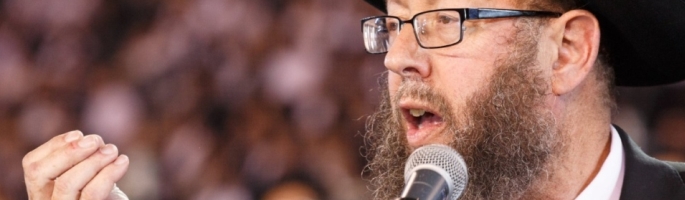

These divrei Torah were adapted from the hashkafa portion of Rabbi Yissocher Frand’s Commuter Chavrusah Tapes on the weekly portion: Tape # 526, A Million Dollars to Tzadaka If… Good Shabbos!
Making A Deal With The Almighty In The Tradition of Yaakov Avinu
This week’s parsha contains an incident of a “conditional vow” made to the Almighty. “Then Yaakov took a vow saying, ‘If G-d will be with me, and He will guard me on this way that I am going; and He will give me bread to eat and clothes to wear, and I will return in peace to my father’s house, and Hashem will be a G-d to me – then this stone which I have set as a pillar shall become a house of G-d, and whatever You will give me, I shall surely tithe to You.” [Bereishis 28:20-22]
In effect Yaakov makes a deal here with the Master of the Universe. This has been a time-honored tradition in the Jewish nation that people have in effect made deals with the Almighty. I would like to share an incident that I heard in the name of Reb Chatzkel Besser. He personally heard this story from the Sadegerer Rebbe in Tel Aviv.
So much of life is being in the right place at the right time or being in the wrong place at the wrong time. The Sadegerer Rebbe had to be in Vienna on Shabbos Parshas Zachor, March 12, 1938. That was a very inopportune Shabbos to be in Vienna. On that Friday the brown shirted Nazis marched into Vienna and ransacked Jewish homes. Subsequently, the Nazis invaded Vienna and that was the beginning of the end for Viennese Jewry.
[Ironically, the famous Reichman Family was also in Vienna in 1938. That Shabbos was supposed to be the Bar Mitzvah of the eldest brother Edward Reichman. Unfortunately — or at least what they thought was unfortunate at the time – Mrs. Reichman’s father who still lived in Hungary (in Beled) had a stroke. They wanted very much that the grandfather should be at the Bar Mitzvah, but he was in no condition to travel to Vienna. So the week before the Bar Mitzvah the Reichman family with three of their children left Vienna to celebrate the Bar Mitzvah in Hungary. Samuel Reichman (the father) never stepped foot in Vienna again. That is how he was able to make it out of Europe. He fortuitously happened to be in Hungary.]
The Sadegerer Rebbe had no such luck. The brown shirted Nazis zeroed in on every prominent Jew they could find. They grabbed Jews out of cabs out of shuls, out of every place they could find them. They captured the Sadegerer Rebbe. This is the background to the story I want to tell. I will relate what happened to him very soon.
Years later, Reb Chatzkel Besser visited Tel Aviv. Early one morning, he was walking into the shteible of the Sadegerer Rebbe. He noticed the Jewish street cleaner sweeping the street and the sidewalk on the block of the shteible. When the street cleaner reached the sidewalk immediately in front of the shteible, he stopped sweeping, walked past the shul, and then resumed his cleaning operation on the next block.
Reb Chatzkel Besser sensed anti-religious discrimination here and went over to the street cleaner and objected. “What’s wrong with this piece of sidewalk?” The street cleaner responded “HaRebbe lo noten reshus” (The Rebbe does not allow me to sweep there.) Reb Chatzkel Besser did not believe him and repeated his question to which the street cleaner repeated the same answer.
He thought the street cleaner was making up the story or just being lazy. He went into the Rebbe and asked him directly “Why won’t the street cleaner sweep in front of your shteible?” The Rebbe put him off and did not give him a straight answer. This was Friday morning. He kept badgering the Rebbe Friday night, Shabbos morning, Shabbos afternoon: “What does it mean ‘HaRebbe lo noten reshus’?”
At the end of Shabbos the Rebbe explained the true story to his guest. When he was in Vienna that Shabbos in March 1938 the Nazis took him and dressed him up in one of the uniforms of the street cleaners of Vienna and they gave him a tiny little broom. They placed him by the steps of the Vienna Opera House and ordered him to clean every step.
Of course, this was a humiliating experience for the Rebbe. He was wearing one of those little street cleaner’s caps and essentially holding a tooth brush, cleaning the massive steps of the Vienna landmark. He related that at that moment he made a “deal” with the Ribbono shel Olam. He said, “Master of the Universe, if You help me escape from here I promise You I will sweep the streets of Eretz Yisrael.”
He made it out and he kept his promise. When he arrived in Eretz Yisrael and set up a shteible there, he accepted upon himself that he would not let anyone sweep outside his shteible – he would do it himself. Every day, he would sweep the sidewalk in front of his shul because of the deal he made with the Almighty, in the tradition of Yaakov Avinu.
Yaakov Approached The Shepherds Like A Brother
I would like to relate another story I just read, this one involving the Ponnevetzer Rav. The parsha contains the following narration, immediately after Sheni:
“So Yaakov lifted his feet, and went toward the land of Bnei Kedem. He looked and behold – a well in the field! And see there! Three flocks of sheep lying beside it, for from that well they would water the flocks, and the stone on the mouth of the well was large. And all the flocks would be gathered there, and they would roll the stone from upon the mouth of the well and they would water the sheep; then they would return the stone onto the mouth of the well, to its place. Yaakov said to them, ‘My brothers, where are you from?’ And they said, ‘We are from Charan.’…He said, “Look the day is still long; it is not yet time to bring the livestock in; water the flock and go on grazing. But they said, ‘We are unable to, until all the flocks will have been gathered and they will roll the stone from upon the mouth of the well; and we will water the flock.” [Bereishis 29:1-8]
Yaakov Avinu is a stranger in the city. He arrived mid-day and saw the shepherds were apparently sloughing off. He criticized them for taking off so early. He told them they should be out in the field yet grazing with their sheep! They explained to Yaakov the special circumstance that caused them to come in when they did.
The Ponnevetzer Rav asked a question on this narration. This is apparently akin to the following scenario: We drive by and see construction workers who are supposed to be fixing a pipe or fixing the street or fixing a fire hydrant. It is two o’clock in the afternoon and we notice that they are taking off from work. Here they are, State employees and instead of working they are all sitting on the ground shmoozing. It is not lunch hour. We wonder what they are doing there.
We approach them and say, “Fellows, how are you? You know it is really not right that you should be taking off at 2 o’clock in the afternoon. There is still plenty of daylight. You have not put in your eight hours yet. Tell me, guys, why are you knocking off so early?”
Trust me, we would not receive the same answer that Yaakov Avinu received. At best they would tell us “Mind your own business! Who are you? Bug off!” (This is the sanitized version of what they would tell us.)
In effect, Yaakov Avinu tells these strangers the same thing. The Ponnevetzer Rav asked why did he get such a polite response from them? How did Yaakov Avinu get away with it?
The Ponnevetzer Rav answers that the key to the polite response is how he first approached them. He introduced himself by saying to them “My brothers, where are you from?” He called them his brothers. More than that, he succeeded in demonstrating to them that he felt like a brother to them. They felt his sincere concern. They felt that he was speaking to them like a kinsmen. When one feels that way about people, one can get away with giving them honest criticism and encouragement to improve their ways.
The Ponnevetzer Rav was himself such a person. When he talked to another Jew, the Jew felt like he was talking to a brother. He was one of the most — if not THE most — successful fundraisers in the history of modern Yeshivas. He was so successful because he was able to convey this spirit of “My brothers”. People felt like the man cared for them.
I recently read a story that Rabbi Berel Wein wrote reminiscing about his years as a Rabbi in Miami Beach when the Ponnevetzer Rav used to come for annual fundraising visits. Rabbi Wein drove him around and went with him to see some of the prominent members of the Jewish community.
The Ponnevetzer Rav entered the office of a young businessman. In past years, he had received generous donations from the man’s father and grandfather. However this young man was very full of himself. He was very wealthy and very full of chutzpah. Not only did he refuse to give any money to the Ponnevetz Yeshiva, he dressed down the Ponnevetzer Rav in a disgusting fashion: “I don’t need you and I don’t need your Yeshiva and I don’t need other Yeshivas and you and your old fashion ways can get out of this office and never come back.”
The Ponnevetzer Rav sat there without saying a word. When the man finished his diatribe, he shook his hand and walked out of the office, in total silence. While walking to the car with Rabbi Wein, the Ponnevetzer Rav began crying. Rabbi Wein tried to reassure him. “Don’t worry. The next fellow will give us more. You will make up this loss. Don’t worry.”
The Ponnevetzer Rav told Rabbi Wein “I am not crying about the lost donation. I am not crying because the Ponnevitz Yeshiva will get $500 or $1000 less this year. But every Jew has to have a connection to Torah. If he does not have a connection to Torah he will be lost. This man was not religious. He certainly did not learn Torah. But his connection to Torah was that at least his father and grandfather supported Yeshivos. At least they had some kind of connection to Torah. If this man stops giving me money and stops giving money to Yeshivos, that is it — he will be lost to Judaism.” That was why the Ponnevetzer Rav was crying – not over the lost check, but over the lost soul. The Ponnevetzer Rav’s connection to people was one of “you are my brethren.”
Rabbi Wein concluded with the following point: This incident happened over 35 years ago. Thirty-five years ago the connection of non-Observant Jews with Judaism was that they gave money to Yeshivas. In the last 35 years many people no longer even give money to Yeshivas. The last remaining link for many to Judaism is Eretz Yisrael. They still give money to Israel Bonds or the Jewish National Fund. At least they have some connection to the Jewish people.
But sometimes we find that these same people are not happy about certain things that happen in Eretz Yisrael and they threaten “if the legislation does not go the right way, we are going to cut off our donations to Israel”. The great tragedy is not the loss for Israel. Israel will make it with or without the contribution of these American Jews. The tragedy is that these people’s last tenuous connection with Judaism is going to be severed. If that happens, they will be severed from the Jewish people.
Our reaction must not be “Nu, let them leave!” Our reaction must be like that of the Ponnevetzer Rav. He was mourning and crying over a lost soul.
This write-up was adapted from the hashkafa portion of Rabbi Yissocher Frand’s Commuter Chavrusah Torah Tape series on the weekly Torah portion. The complete list of halachic topics covered in this series for Parshas Vayeitzei are provided below:
Tape # 032 – The Obligation to Give Ma’aser
Tape # 074 – Honoring Parents Who Are Not Observant
Tape # 123 – Tefilla B’tzibur: Is It Mandatory?
Tape # 170 – Marrying Off a Younger Child First
Tape # 216 – Maariv
Tape # 260 – “Ein Mearvin Simcha B’Simcha”
Tape # 306 – Making a Neder During Times of Trouble
Tape # 350 – Must Women Daven?
Tape # 394 – Accepting Tzedaka from Women
Tape # 438 – The Mitzvah of Mesameach Chasan V’Kallah
Tape # 482 – Davening to a Malach
Tape # 526 – A Million Dollars to Tzadaka If…
Tape # 570 – Tuition and Maaser Money
Tape # 614 – The Tefilah of Baruch Hashem L’Olam Omein V’Omein
Tape # 658 – Lashon Aramis – Aramaic
Tapes or a complete catalogue can be ordered from the Yad Yechiel Institute, PO Box 511, Owings Mills MD 21117-0511. Call (410) 358-0416 or e-mail [email protected] or visit http://www.yadyechiel.org/ for further information.
Text Copyright © 2006 by Rabbi Yissocher Frand and Torah.org.
Transcribed by David Twersky; Seattle, Washington.
Technical Assistance by Dovid Hoffman; Yerushalayim.