

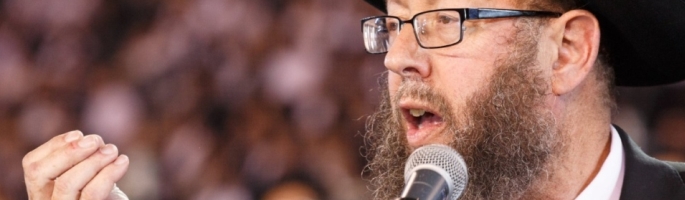

These divrei Torah were adapted from the hashkafa portion of Rabbi Yissocher Frand’s Commuter Chavrusah Tapes on the weekly portion: Tape # 606, Succos – Danish and Coffee in the Succah? Good Shabbos!
The Torah Is Not Yerusha – Only Morasha
The Torah reading on Simchas Torah contains the well known pasuk [verse]: “The Torah was commanded to us by Moshe, a Morasha [inheritance] to the Congregation of Yaakov.” [Devorim 33:4] There is an interesting teaching in the Talmud Yerushalmi: Everywhere we find the word morasha, it connotes a weakening of the idea of inheritance (lashon deeha) [Bava Basra 8:2].
Morasha is a peculiar word. It is not easy to translate. It is significantly different than the word yerusha [inheritance]. The connotation is that one has less ownership in an object that has come to him as a “morasha” than he does in an item that comes to him as a “yerusha.”
The Jerusalem Talmud is not referring to the source in our pasuk in Zos HaBracha but rather to a pasuk in Parshas VaEra: “And I will give it (referring to the Land of Israel) to you as a morasha.” [Shemos 6:8] The Yerushalmi points out that the people who were given this promise never made it to the Land of Israel. Virtually the entire generation who left Egypt died out in the Wilderness. How then can the Torah make the statement that it will be given to them as a morasha? The Yerushalmi thus cites this as proof for the difference in nuance between yerusha and morasha.
Had the Torah promised Eretz Yisrael to those who left Egypt as a yerusha, it would have belonged to them with no ifs, ands, or buts. However, the Torah used the weaker form — morasha, meaning that it will not necessarily be yours. In truth, it never became theirs.
It only became theirs to the extent that they gave it to their children. This in fact is the major connotation of the word morasha. The word implies “it is yours – sometimes literally and sometimes only to the extent that you pass it on to your children without ever having taken possession.”
The Yerushalmi then questions this explanation by citing our pasuk regarding the Torah being a “morasha for the Congregation of Yaakov.” The Yerushalmi answers that in fact this translation of ‘morasha’ applies to Torah as well!
Torah is NOT a yerusha. Just because my father had the Torah does not mean that I will have the Torah. Sometimes a person only has the Torah as a ‘morasha’. This means that if a person sweats over Torah and makes the effort to understand Torah and puts in the hours required to master Torah, then Torah actually becomes his. But there is no guarantee. Torah is not a no-strings-attached inheritance (yerusha). Without the sweat and the hours, Torah will only be something that the person can potentially pass on to the next generation (morasha).
Chazal teach a tradition based on the pasuk, “This Torah will not depart from your mouth or the mouths of you children or the mouths of your grandchildren forever” [Yehoshua 1:8]: If three generations are committed to learning Torah, then the Torah will never leave that person’s family. The Talmud [Bava Metzia 85a] summarizes this idea with the expression “The Torah returns to its host” (Torah chozeres al achsania shelah).
Someone once asked the Chofetz Chaim the very obvious and pointed question that we know people who descend from many generations of Torah scholars who are themselves ignorant of Torah. Unfortunately, we see millions of Jews that fit into this category. There are families that bear the name of prestigious Gedolim [Torah greats], who today may not even know what an Aleph looks like. What then does it mean “Torah chozeres al achsania shelah”?
The Chofetz Chaim explained that the Gemara’s analogy is very precise. The Torah is like a guest seeking its host’s home. Sometimes a guest knocks on one’s door. If no one answers the door, the guest will not come in.
“Torah chozeres al achsania shelah” means that if Torah has been in a family for three generations, the Torah will come “knocking on that family’s door” in future generations. But still, the younger generation must open the door for the guest. The guest must still be invited in by each new generation.
Unfortunately, this does occur. There is knocking. There are opportunities. But the door does not get opened. Torah is not a yerusha. It is only a morasha. The difference is that the former is automatic, while the latter requires effort. If a person does not make the effort, his relationship to Torah might only be to the extent that he will pass it on to subsequent generations.
The Value of an Unknown Burial Place
In Zos HaBracha, the Torah teaches that the burial place of Moshe Rabbeinu is not known. [Devorim 34:6]
I read an interesting story recently about someone who was driving in Eretz Yisrael in the Golan Heights. He came to an intersection and picked up two Israeli soldiers who were hitchhiking. The soldiers piled into the back seat with their M-16s and started up a conversation.
As it turned out, the soldiers were not Jews, they were Druze. The Druze are loyal citizens of the State of Israel and serve in the Israel Defense Forces. They also have a difficult history with the Arabs.
The Druze soldiers explained that they have their own religion. They are not Moslem. The “father” of their religion is Yisro. They had a nice discussion and as they got to their destination and started leaving the car, the soldiers left the Jewish driver with a parting thought: “Our religion has something over your religion. Not only do we have something over your religion, we have something over the Christians and the Moslems as well. We know where the ‘father’ of our religion is buried. (Yisro is buried in the area around Teverya.) You do not know where Moshe is buried. The Christians do not know where the founder of their religion is buried. The Moslems do not even know IF the founder of their religion is buried. (According to their tradition, he ascended to Heaven before dying.)”
However, the truth is that it is not necessarily good to know where a person is buried. The Torah makes a point of telling us that we do not know and we will not know where Moshe is buried. The Talmud describes an attempt to locate the grave of Moshe Rabbeinu on Mount Nebo [Sotah 13b]. The attempt was foiled supernaturally. Why?
Rav Samson Rafael Hirsch explains that the Torah saw the potential that Moshe Rabbeinu’s grave could become a deity. It is important for all of us to remember that when we visit the graves of the righteous, we do not pray TO the righteous people that they should bless us. We are forbidden to pray TO a human being – dead or alive! We visit the graves of Tzadikim to ask that they petition on our behalf to the Ribono shel Olam. We are not allowed to daven TO the Tzadik.
The Torah saw the potential of such a thing happening with Moshe Rabbeinu. Moshe was a person of such monumental stature that the Torah feared lest his burial place would become a shrine.
The Torah is also informing us that as monumental a person as Moshe Rabbeinu was, there needed to be a new leader once he died. No one could fill his shoes, but that was irrelevant. Life must go on. The Torah stresses this idea by emphasizing, “You will come to the Judge who will be present IN THOSE DAYS” [Devorim 17:9] and “You will come to the Priest who will be present IN THOSE DAYS.” [Devorim 26:3]
The fact that this Judge or this Priest is not in the same league with his predecessor is irrelevant. We are told that Moshe’s face was like the sun and Yehoshua’s face was only like the moon. Yehoshua was not in the same league as Moshe. But Yehoshua was going to be the new leader.
Rabbi Wein always quotes the maxim: “No man is indispensable, yet no man is replaceable.” This is very true. No man is indispensable to the extent that “we cannot continue onward.” Yet no man is replaceable either. People have their own unique contributions that can never be replaced.
This is another explanation of why Moshe’s burial place is not known. The Jewish people had to move forward. They had to continue with the next leader and the next generation. “A generation passes on and a new generation comes.” [Koheles 1:4] We can only go to the leader who is present in our own generation. This is the way of the Torah and this is the way of the world.
Text Copyright © 2006 by Rabbi Yissocher Frand and Torah.org.
Transcribed by David Twersky; Seattle, Washington.
Technical Assistance by Dovid Hoffman; Yerushalayim.