

Pesach
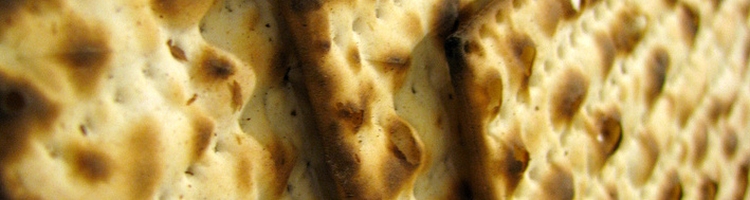
The splitting of the matzo, and the time of each piece’s use, have important significance. The Chasam Sofer tells us that each piece alludes to half of the Seder. The half that we ate already alludes to the first half of the Seder. In the first half of the Seder, we thanked Hashem for our redemption from Egypt. However, we are still in exile now, and further redemption is needed. In the second half of the Seder, we ask Hashem for this redemption. The piece of matzo we eat now symbolizes this. Just as this piece of matzo was hidden away, so is the date of our final redemption.
Barech
When there are three or more men over the age of thirteen who participated in the same meal, they are obligated to say Birchat HaMazon, Grace after Meals with Zimun, a special invitation to say Birchat HaMazon. Rashi explains that this means that all are invited to together say a blessing to Hashem. On this, both the Abudraham and the Kol Bo say that the reason we have this invitation and unified blessing is to increase the praise and greatness of Hashem. We announce together, after we have finished our meal, how we praise Hashem, and to thank him for the abundance of goodness he has bestowed upon us.
Hallel, Nirtza
The Maharal explains that Hallel and Nirtza are not two distinct steps of the Seder. Rather, it is one step, known as Hallel Nirtza. He explains that those who say Nirtza is a step of itself explain the meaning of the step as being “if one conducted his Seder this way, it is desired (nirtza) before Hashem. However, if this were the meaning of Nirtza, it would not be explaining what we are doing in this step, but rather it would be referring to what we did in all previous steps. This is unlike the title of every other step, which refers to what we do in that step. Therefore, the true name of the step is Hallel Nirtza, referring to the second time we are saying Hallel tonight. The first time we said Hallel tonight, it was a plain Hallel. We were thanking Hashem for all the miracles of Egypt. Now, we are praying to Hashem that we should have a complete redemption. We request in this Hallel that it should be pleasing (nirtza) before Hashem to perform wonders and miracles for us as well. Hence, this is a Hallel Nirtza.
Before we actually begin saying the Hallel Nirtza, we begin by opening the door and saying Sh’foch Chamascha. The Maharal explains that purpose of this Hallel Nirtza is to arouse the mercy of Hashem so that we should merit pleasing him and that He should find favor in us so that we are granted complete redemption. Therefore, we are obligated to make known to our children and publicize a principal belief which we have received from the prophets. This belief is that Eliyahu HaNavi will arrive right before our redemption to announce the impending arrival of Moshiach. As we are now praying for this redemption to occur, we open the door for Eliyahu, the one who will announce our redemption, and pour him a special cup of wine, a Kos Yeshuos, a cup of salvation for the future redemption.sss
The opening of the door at this point is solely because we want to welcome Eliyahu, the announcer of the redemption that we are about to pray for. It is not connected to the saying of Shfoch Chamascha . We precede our Hallel with this request because it is a fitting preface to the first passage of the Hallel we are about to say, Lo Lanu. The Maharal says that we are familiar with the fact that Chazal have told us we are to make sure to pray before tzaros, troubles, happen. We know that the war between Gog and Magog will occur before Moshiach and our redemption comes. As the gates of heaven are now open and we are praying for our redemption, we say first that Shfoch Chamascha- Hashem should take His wrath out on the nations that don’t recognize Him, for they have persecuted us. Then, in Lo Lanu, we continue and say that none of this wrath should be taken out on us – Lo Lanu – even though we may not be worthy to this on our own merit. Even so, we ask that Hashem should do it for the honor of his name – Kavod shimcha.
The Leil Shimurim also connects the saying of Shfoch to Lo Lanu, which follows. We ask Hashem to pour out his wrath on those who do not know Him and who do not call in His name. This is because those nations did two evil deeds – they devoured Ya’acov (the nation of Israel) and laid waste to his dwelling place (the holy temple). The decree that Hashem issued on the Jews was only that the Holy Temple would be destroyed. The murder of the nation of Israel was not in that decree. This is something the nations took upon themselves to do. We therefore, in Lo Lanu, ask Hashem to spare us, as we give His name reverence. The Abarbanel adds that this nation that “did not know Hashem” are the nations that are like Egypt, who saw the greatness of Hashem, but still refued to acknowledge him. We ask that if Hashem poured out his wrath on Egypt, he should pour out his wrath on nations that do worse to us, that consume us, and destroy the Holy Temple. Even though we may not be deserving of this special treatment, we ask that Hashem do it so that the nations of the world will know His true power and recognize Him.
The Ma’ainah shel Torah writes that the Avnei Ezel explained the reason we say Hallel now by means of a parable. A father was greatly angered by his son to the point where forgiveness was unlikely. The son greatly wanted to get back on his father’s good side. Therefore, when a large group of people were gathered around, the son began singing the praises of the father extensively, in front of everyone. When the father saw that his son, who could very well have been upset at him as well for not forgiving him, not only sang praises, but in front of a large group, he weakened and found favor with his son. Similarly by us. We, who may have upset Hashem, will not hold back in our singing of praises to Hashem until we reach the point of Nirtza- that Hashem finds favor in us.
 |
Rachtza-Schulchan Orech | Why Next Year in Jerusalem? |  |